

ARTICLES & INSIGHTS
Practical guidance for healthier relationships
Explore compassionate, research-informed articles about mental load, communication, intimacy, partnership, motherhood, and personal growth.

FEATURED ARTICLE
MARCH 28, 2026
How Parenthood Magnifies Imbalance
Parenthood can widen small inequalities into major divides. Explore how couples can recognize the imbalance, share ownership, and reconnect before survival mode becomes the norm.
Find the guidance you need
BROWSE BY TOPIC
Insights for everyday relationships
LATEST ARTICLES

Article 32: How Parenthood Magnifies Imbalance
Before children, many couples operate in a flow that feels balanced enough. The division of labor might not be perfect, but it’s manageable. Then comes parenthood — and suddenly, the cracks widen. What was once a minor imbalance becomes a gaping divide. Parenthood magnifies inequality in labor, emotional load, and time — and it often happens so fast that couples don’t realize it until they’re in survival mode.
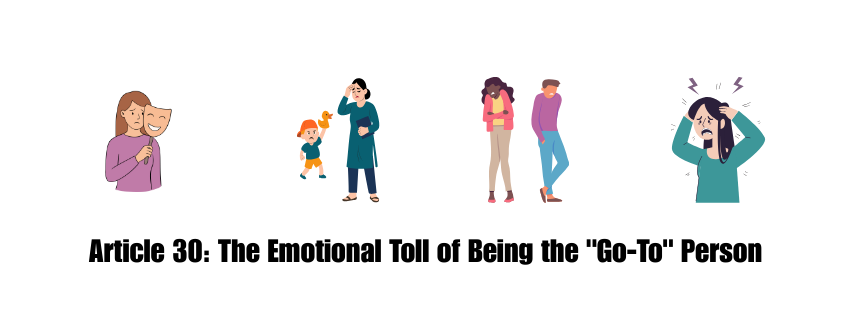
Article 30: The Emotional Toll of Being the "Go-To" Person
Every household has someone who’s the default. The go-to person. The one everyone turns to when something needs doing, when something breaks, when emotions run high, or when someone forgets. For many women, that role becomes more than a responsibility — it becomes an identity. And over time, it takes a toll.

Article 29: Feeling Alone While Surrounded by People
There’s a particular kind of loneliness that doesn’t come from being physically alone — it comes from carrying too much, unnoticed, in the presence of others. This form of emotional isolation is common among those who hold the mental and emotional weight of their households. They’re surrounded by people they love, yet feel invisible in the very systems they maintain.

Article 28: How Mental Load Affects Intimacy
At first glance, intimacy might seem unrelated to mental load. But the truth is, intimacy — both emotional and physical — thrives on connection, safety, and reciprocity. When one partner is overwhelmed by invisible labor and the other remains unaware, the emotional gap that forms doesn’t just affect day-to-day functioning — it shows up in the bedroom and in the depth of the relationship.

Article 27: Burnout from Overfunctioning
Overfunctioning is what happens when one partner consistently takes on more than their share — not just out of love, but out of necessity. It’s stepping in to fix, manage, support, and smooth everything over because it feels like no one else will. And while it may seem admirable on the surface, overfunctioning is a fast track to emotional burnout.

Article 26: The Cost of Never Shutting Off
One of the most exhausting parts of carrying the mental load is that it never ends. It’s not a task you complete — it’s a constant, low-level hum in the background of your life. This inability to mentally or emotionally shut off has a steep cost: burnout, resentment, and a deep longing for rest that rarely comes. For many women, the mental switch never flips to "off." And over time, that chronic alertness becomes unsustainable.

Article 25: Feeling Like the “Household Parent” to Your Partner
In a balanced relationship, both partners act as equals. But when the mental and emotional load becomes one-sided, one partner often slips into a different role — that of the “household parent.” This dynamic can feel like parenting your partner instead of partnering with them. It's not always intentional, but over time, it creates resentment, emotional distance, and burnout.

Article 23: Communication Breakdowns Around Invisible Labor
One of the most frustrating aspects of the mental and emotional load is how hard it is to talk about. When the labor is invisible, the need often is too — and attempts to communicate it can quickly lead to defensiveness, confusion, or conflict. These breakdowns can leave the partner who carries the load feeling even more isolated. And over time, the inability to talk about it becomes as heavy as the labor itself.

Article 21: Emotional Labor vs. Mental Load
In conversations about household dynamics and relational strain, two terms often come up: emotional labor and mental load. They’re sometimes used interchangeably, but they describe different — though often overlapping — aspects of the invisible work many women carry. Understanding the distinction between these two concepts is key to developing shared responsibility and deeper empathy in relationships.

Article 19: Gender Scripts in Heterosexual Relationships
Every couple enters a relationship with a set of assumptions — many of which are never explicitly discussed. These assumptions are part of what researchers call "gender scripts": culturally conditioned expectations about how men and women are supposed to behave in romantic relationships. Gender scripts influence everything from who plans dates to who sacrifices career opportunities for the family. Left unexamined, they can create deeply ingrained patterns that reinforce inequality and mental load imbalance.

Article 18: Women's Roles as Default Managers at Home
In many heterosexual relationships, women are not just partners — they become the default managers of the home. This role includes not only executing tasks but also anticipating needs, organizing logistics, and emotionally supporting everyone. Being the default manager means carrying the mental blueprint of the household — and it often happens by default, not by choice.

Article 16: The Impact of Early Life Gendered Chores
The division of labor in adulthood doesn’t begin when we move in with a partner — it starts much earlier, in childhood. The chores we’re assigned, the praise we receive, and the behaviors we’re encouraged to adopt all play a role in shaping how we think about responsibility. For many, early gendered chore assignments lay the foundation for the unequal mental load that shows up later in relationships.

Article 14: Media’s Role in Gender Role Perpetuation
Media reinforces outdated gender roles that shape mental load at home. Learn how to recognize these patterns—and how to challenge them for better balance.

Article 13: How Boys and Girls Are Socialized Differently
Explore how early gender socialization impacts adult responsibilities and mental load—and how couples can rewrite outdated roles for true partnership.

Article 11: Imbalance of Power Between Men and Women
Introduction At the core of the mental load conversation lies an uncomfortable truth: power in heterosexual relationships is often unequally distributed. This imbalance isn’t always about who earns more or who makes the final decisions. It often hides in more subtle places — like who is expected to plan, manage, and emotionally tend to the household. Understanding how this power imbalance shows up is essential to building a truly equal partnership.

Article 10: Societal Norms Reinforcing Unequal Load Distribution
Introduction Mental load doesn’t develop in a vacuum — it’s shaped by the society we live in. From media messages to cultural traditions, the world around us constantly reinforces the idea that women should be the primary caretakers and organizers of home life. These societal norms are powerful forces, silently dictating expectations and shaping behavior.

Article 9: Gendered Assumptions About Task Ownership
Introduction In many households, who does what isn’t just based on skills or availability — it’s rooted in deeply ingrained beliefs about gender. These beliefs, often unspoken, shape who is expected to notice what needs to be done, who takes charge without being asked, and who feels responsible when things slip through the cracks. Understanding these assumptions is essential to dismantling the mental load imbalance.

Article 8: Reviewing Tasks and Mental Checklists
Introduction At the heart of the mental load is the constant mental reviewing — running through checklists, double-checking tasks, and assessing what’s next. This process is rarely seen but is crucial to making sure nothing falls through the cracks. Reviewing is more than glancing at a to-do list; it’s a form of mental project management that keeps the entire household operating smoothly.

Article 7: Delegating Responsibilities and the Emotional Toll
Introduction Delegating tasks might seem like a straightforward solution to lighten the mental load — but it’s not that simple. For many women, delegating comes with its own burden. It’s not just about handing off a chore; it’s about thinking through what needs to be done, explaining it, monitoring the results, and dealing with the emotional fallout if it doesn’t get done correctly or on time. Delegation, when not approached with care and understanding, can actually add to the load rather than relieve it.

Article 6: Remembering Tasks as Part of Mental Load
Introduction One of the most overlooked yet mentally taxing components of the mental load is remembering. It’s not just about memorizing dates or items on a to-do list. It’s about holding the cognitive responsibility for an entire household’s needs, timelines, and preferences — and doing it around the clock. Remembering, in this context, is not passive. It’s an active and constant task, quietly demanding energy and attention.