
DIGITAL RESOURCES
Tools for Insight, Connection & Growth
Explore practical, thoughtfully created resources designed to support healthier relationships, meaningful reflection, emotional well-being, and lasting personal growth.
Resources You Can Use in Real Life
PRACTICAL
Clear information and useful exercises that help turn insight into meaningful action.
DOWNLOADABLE
Resources are delivered digitally, giving you convenient access from your computer, tablet, or phone.
THOUGHTFULLY CREATED
Developed with care to support individuals, couples, and helping professionals in learning, reflection, and growth.
BROWSE THE RESOURCE LIBRARY
Choose a resource below to learn what it includes, who it was created for, and how it can be used. Unless otherwise stated in the individual listing, products are digital downloads, and no physical item will be mailed.
Relationship
Booklets
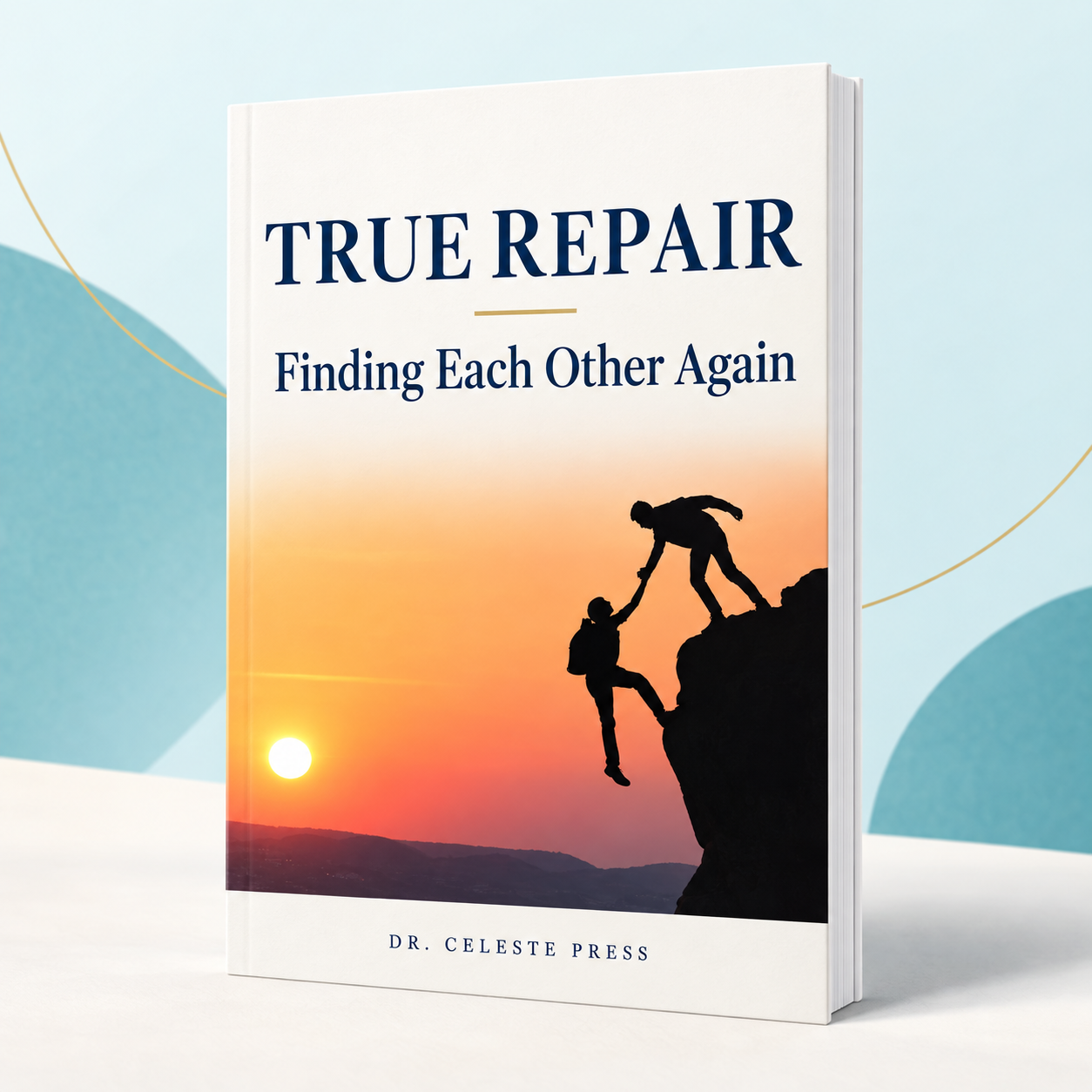
Learn what genuine relationship repair looks like when an apology alone is not enough.
True Repair: Finding Each Other Again is a research-informed relationship guide to reconnection through an attachment and Emotionally Focused Therapy lens.
Repair is not simply ending an argument, changing the subject, or saying “I’m sorry.” True repair involves stopping the harm, understanding its emotional and attachment impact, accepting responsibility, responding to the vulnerable need underneath the conflict, and creating reliable behavioral change.
This guide helps couples understand why some injuries continue to return, identify the protective cycle that keeps them disconnected, and practice a structured pathway toward renewed safety and trust.
WHO THIS RESOURCE IS FOR
This guide may be especially helpful for:
• Couples who struggle to reconnect after conflict
• Partners who apologize but remain stuck in the same recurring pattern
• Couples healing from broken trust or significant disconnection
• People who become caught in pursue-withdraw cycles
• Partners who want to give or receive a more meaningful apology
• Couples learning how to discuss attachment injuries
• People deciding whether repair is genuine or stalled
• Therapists seeking a relationship-education recommendation for clients
WHAT YOU’LL LEARN
• Why ending an argument is different from repairing the relationship
• The attachment questions underneath conflict
• How everyday disagreements acquire deeper meanings about trust and connection
• How protective strategies create pursue-withdraw cycles
• What makes an attachment injury different from an ordinary disagreement
• Why painful events may continue to return until the attachment question is answered
• The difference between healthy remorse and shame that redirects attention
• How to take specific responsibility without blame, dilution, or defensiveness
• How to respond to triggers as echoes of an earlier injury
• Why reliable behavior is necessary for rebuilding trust
• Why forgiveness remains a choice rather than an obligation
• How to recognize when joint repair is unsafe or inappropriate
THE FOUR-STAGE REPAIR PATHWAY
The guide introduces a repeatable repair pathway.
THE R.E.P.A.I.R. CONVERSATION
The guide introduces a repeatable repair process.
PRACTICAL TOOLS
The booklet includes:
• Attachment-based reflection prompts
• A description of the pursue-withdraw cycle
• A four-stage repair pathway
• The R.E.P.A.I.R. conversation process
• Scripts for injured and responsible partners
• Language for recognizing and interrupting the cycle
• A six-part repair-centered apology
• Guidance for different protective strategies
• A personal Repair Map worksheet
• A 20-minute weekly repair check-in
• Signs that repair is working or has stalled
• A one-page review for planning the next repair step
• Selected peer-reviewed research
A TRUE APOLOGY
The guide explains six parts of a repair-centered apology.
IMPORTANT SAFETY INFORMATION
Couple repair requires enough freedom and safety for both partners to speak honestly.
Joint vulnerability may be unsafe or ineffective when a partner uses violence, threats, coercive control, stalking, intimidation, isolation, sexual coercion, retaliation, severe destabilizing substance misuse, ongoing consequential deception, or continued affair involvement outside the couple’s agreements.
Abuse is not a mutually created attachment cycle. Understanding context does not transfer responsibility away from the person choosing coercion, intimidation, or violence.
Repair also does not require reconciliation. Safety, consent, dignity, and freedom of choice are more important than preserving a relationship.
FORMAT AND DELIVERY
This is a digital product. No physical product will be shipped.
File format: PDF
Length: 22 pages
Page size: US Letter
Designed for: Digital reading or printing
After completing your purchase, follow the provided download instructions and save a copy to your device.
EDUCATIONAL INFORMATION
This guide provides general relationship education. It is not a substitute for individualized psychotherapy, medical care, legal advice, domestic-violence services, safety planning, or emergency support.
In immediate danger, contact emergency services or an appropriate domestic-violence resource in your location.
LICENSE AND PERMITTED USE
Your purchase includes a license for individual or relationship use. You may save a copy, print the guide for yourself, and share it with your partner for use within your relationship.
Please do not share the complete file with friends, colleagues, clients, groups, or your broader community. Instead, share the original Hub Library product link so others can obtain their own licensed copy.
The guide may not be resold, redistributed, republished, uploaded to a shared resource library, altered and presented as another person’s work, or used as a handout for multiple clients without written permission.
DIGITAL-PRODUCT POLICY
Because this digital product is delivered electronically, all sales are final. If you experience a technical problem accessing your purchase, please contact us for assistance.
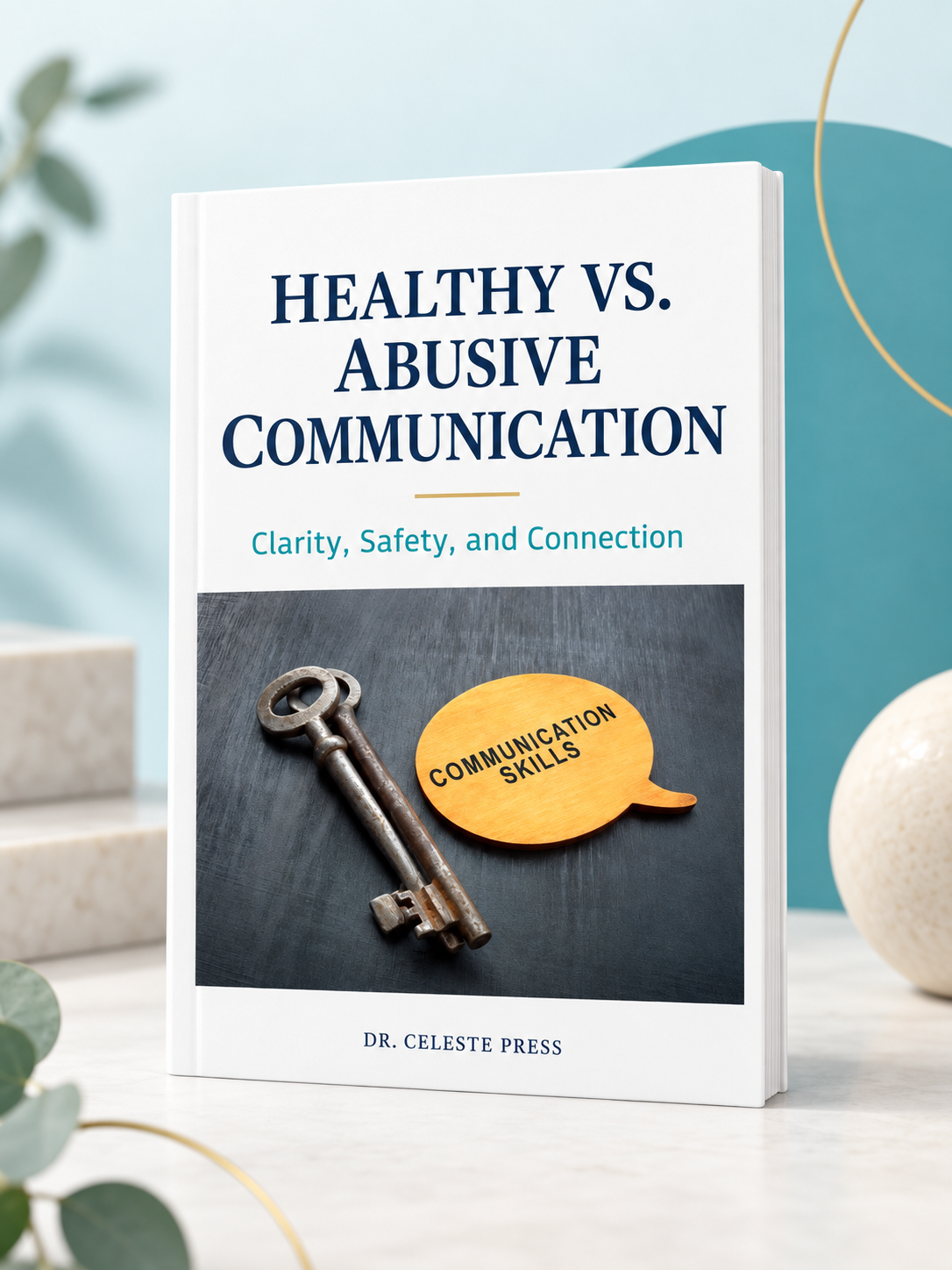
Closeness should not require the loss of safety, dignity, freedom, or self.
Healthy vs. Abusive Communication is a research-informed, attachment- and EFT-informed guide designed to help readers distinguish ordinary relationship conflict from unhealthy communication, emotional abuse, and coercive control.
All couples experience disagreements and may sometimes communicate poorly. What matters is the larger pattern: whether both people retain a voice, whether boundaries and differences are respected, whether responsibility leads to meaningful change, and whether each person remains free to make ordinary choices without fear or retaliation.
This guide examines communication within the broader relational context of power, safety, autonomy, accountability, connection, and freedom. It also explains why abuse is not simply a communication problem and why better communication skills alone cannot correct an ongoing pattern of coercion or control.
WHAT YOU’LL LEARN
• The differences among healthy conflict, unhealthy conflict, abusive communication, and coercive control
• What healthy communication sounds and looks like
• How healthy disagreement allows two realities to exist in the same conversation
• When unhealthy communication may still be repairable
• How emotional and psychological abuse can affect safety, identity, self-worth, and functioning
• How coercive control can restrict another person’s freedom and everyday life
• The differences between disagreement and gaslighting
• How digital monitoring and constant-access expectations can become controlling
• Why jealousy is a feeling—not permission to restrict another person’s autonomy
• How guilt, shame, passive aggression, punitive silence, threats, and intimidation can create compliance
• How emotional abuse can affect the body, nervous system, identity, and sense of reality
• What safety, respect, and secure connection create in a healthy relationship
• The elements of a meaningful apology and genuine repair
• The differences among requests, agreements, boundaries, rules, and controlling demands
• How autonomy and interdependence can coexist within a connected relationship
• The distinctions among secure dependence, interdependence, enmeshment, counterdependence, and dependence without agency
• Why “codependency” is a complicated and inconsistently defined term
• How differentiation helps people remain connected without abandoning themselves
• How attachment fears may explain—but never excuse—harmful behavior
• When an EFT negative-cycle framework may be appropriate and when it may erase responsibility
• Why some situations require specialized assessment before couples therapy
• How healthy relationships make room for both togetherness and individuality
PRACTICAL TOOLS INCLUDED
• A comparison of healthy conflict, unhealthy conflict, abusive communication, and coercive control
• Healthy-communication and healthy-relationship checklists
• Questions for evaluating freedom, safety, dignity, boundaries, and access to resources
• Examples of emotional abuse, gaslighting, digital coercion, isolation, guilt, shame, and intimidation
• Healthy communication and boundary scripts
• Examples comparing secure attachment reaches with controlling protests
• A complete repair and apology checklist
• Guidance for distinguishing boundaries from controlling rules
• Reflection prompts for autonomy, interdependence, differentiation, and relationship safety
• Guidance for recognizing when couples work may be unsafe
• Safety, advocacy, and support considerations
• Selected peer-reviewed research for continued learning
WHO THIS RESOURCE IS FOR
This guide may be helpful for:
• Individuals who want to better understand healthy and unhealthy communication
• People who are questioning whether behaviors in a current or former relationship may be emotionally abusive or controlling
• Individuals who feel confused, frightened, diminished, isolated, monitored, or unable to communicate freely
• Couples examining unhealthy patterns when both partners retain freedom, safety, and the ability to take responsibility
• People learning how boundaries, autonomy, interdependence, and secure connection work together
• Individuals who want practical language for making requests, setting boundaries, pausing conflict, and protecting dignity
• Therapists and helping professionals seeking a comprehensive educational resource for their own professional learning
This resource should not be used to pressure someone to disclose abuse, confront a controlling partner, remain in a relationship, leave a relationship, or participate in couples therapy. Decisions involving abuse, coercive control, separation, or immediate danger may require individualized safety planning and specialized professional support.
FORMAT AND DELIVERY
• One 34-page digital PDF booklet
• Standard US Letter size: 8.5 × 11 inches
• Designed for comfortable reading on a computer, tablet, or mobile device
• May be printed for the purchaser’s permitted individual use
• Delivered electronically as an instant digital download after purchase
This is a digital product. No physical product will be shipped.
EDUCATIONAL INFORMATION
This booklet is intended for educational and reflective purposes only. It cannot determine whether a specific relationship is abusive and is not a substitute for individualized mental-health, medical, legal, advocacy, crisis, or safety assessment.
Abuse can occur across genders, sexual orientations, ages, cultures, abilities, and socioeconomic groups. A person’s attachment history, trauma, fear, jealousy, emotional distress, or mental-health condition does not excuse threats, coercion, degradation, surveillance, sexual pressure, violence, or other abusive behavior.
If a partner may monitor devices or online activity, viewing, downloading, printing, or storing this booklet could increase risk. Consider using a safer device and contacting a domestic-violence advocate for individualized digital-safety and relationship-safety planning.
If you are experiencing coercion, stalking, threats, strangulation, forced sex, physical violence, reproductive coercion, digital monitoring, financial control, confinement, or immediate danger, consider contacting an appropriate emergency service, domestic-violence resource, legal professional, medical professional, or qualified clinician when it is safe to do so.
LICENSE AND PERMITTED USE
Your purchase includes an individual-use license.
You may:
• Download and save the PDF for your own use
• View the booklet on your personal devices
• Print copies for your own personal use
• Review and complete the resource with your partner when appropriate and safe
You may not:
• Share the digital file with friends, colleagues, clients, supervisees, groups, or organizations
• Email, upload, copy, or distribute the PDF to others
• Place the resource in a shared drive, shared library, membership platform, course, or resource collection
• Print or distribute copies as multi-client handouts
• Reproduce, modify, republish, translate, rebrand, sell, or resell any portion of the resource
• Remove the Dr. Celeste Press name, copyright notice, or other identifying information
Each individual or professional who wants a copy must purchase their own licensed copy unless separate written permission or an organizational license has been obtained from Dr. Celeste Press.
DIGITAL-PRODUCT POLICY
Because this digital product is delivered electronically, all sales are final. If you experience a technical problem accessing your purchase, please contact us for assistance.
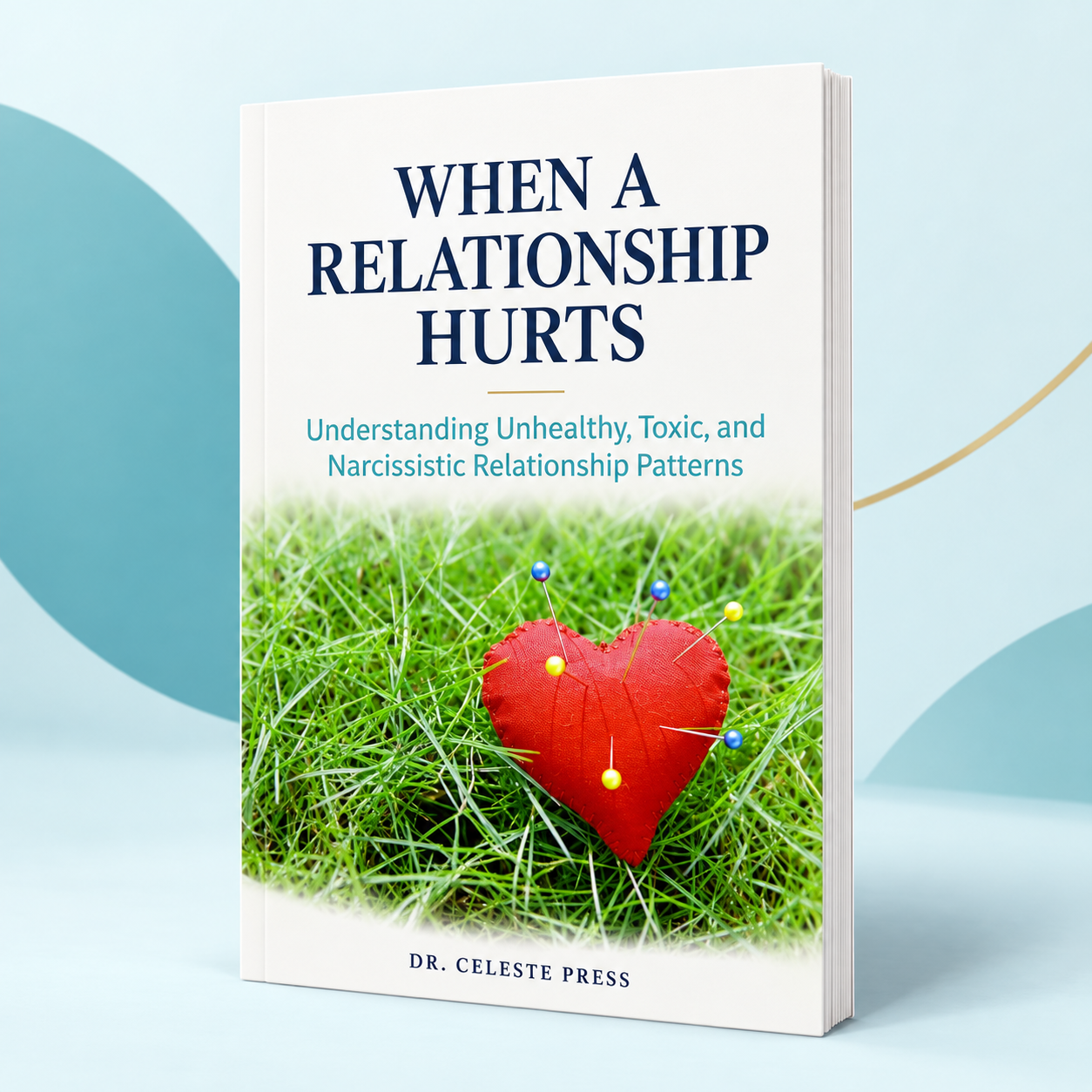
When relationship patterns repeatedly cause pain, confusion, or self-doubt, finding the right label can feel urgent. But understanding what is happening requires more than deciding whether a relationship is “toxic” or whether someone is a “narcissist.”
When a Relationship Hurts is a research-informed, attachment- and EFT-informed guide that helps readers examine observable behaviors, relational patterns, personal impact, accountability, safety, and the potential for meaningful repair.
The guide carefully distinguishes unhealthy relationship distress, toxic relational dynamics, abusive behavior, narcissistic traits, and Narcissistic Personality Disorder. It emphasizes that harmful behavior can be taken seriously without diagnosing a partner or finding the perfect label.
WHAT YOU’LL LEARN
• The differences among unhealthy, toxic, abusive, and narcissistic relationship patterns
• Why narcissistic traits are not automatically Narcissistic Personality Disorder
• How unhealthy patterns differ from persistently harmful relationship climates
• What narcissistic relational patterns may look like inside a relationship
• How chronic invalidation, coercion, and instability can affect the other partner
• How attachment wounds may influence behavior without excusing harm
• When an EFT mutual-cycle framework may—and may not—be appropriate
• Why safety must come before vulnerability
• How to distinguish remorse and promises from meaningful, sustained repair
• How boundaries differ from attempts to control another person
• How to evaluate freedom, dignity, accountability, empathy, and safety across time
• What kinds of professional support may fit different relationship patterns
PRACTICAL TOOLS INCLUDED
• A side-by-side comparison of unhealthy, toxic, and narcissistic relationship patterns
• Questions that help evaluate a partner’s capacity for repair
• Communication, privacy, sexual, and financial boundary examples
• Relationship-clarity questions
• Guidance for matching support to the level of concern and safety
• A personal clarity page for identifying behaviors, impact, requested changes, evidence of change, available support, and the next safest step
• Selected peer-reviewed research for continued learning
WHO THIS RESOURCE IS FOR
This guide may be helpful for:
• Individuals who are confused or concerned about patterns in a current or former relationship
• People trying to understand the differences among unhealthy, toxic, abusive, and narcissistic dynamics
• Individuals who want to evaluate behavior and impact without attempting to diagnose their partner
• People working to identify boundaries, accountability, repair, and safety needs
• Couples examining unhealthy patterns when both partners retain freedom, safety, and the ability to take responsibility
• Therapists and helping professionals seeking a clear educational resource for their own professional learning
This resource should not be used to pressure someone to remain in or leave a relationship. Decisions involving coercion, abuse, separation, or immediate danger may require individualized safety planning and specialized professional support.
FORMAT AND DELIVERY
• One 18-page digital PDF booklet
• Standard US Letter size: 8.5 × 11 inches
• Designed for comfortable reading on a computer, tablet, or mobile device
• May be printed for the purchaser’s permitted individual use
• Delivered electronically as an instant digital download after purchase
This is a digital product. No physical product will be shipped.
EDUCATIONAL INFORMATION
This booklet is intended for educational and reflective purposes only. It does not diagnose Narcissistic Personality Disorder or any other mental-health condition, and it is not a substitute for individualized mental-health, medical, legal, domestic-violence, crisis, or safety advice.
Only a qualified professional conducting a comprehensive assessment can diagnose a mental-health condition. Readers do not need to establish a partner’s diagnosis before taking harmful behavior seriously, establishing boundaries, or seeking support.
If you are experiencing coercion, stalking, threats, sexual or physical violence, digital monitoring, financial control, or immediate danger, consider contacting an appropriate emergency service, domestic-violence resource, legal professional, or qualified clinician when it is safe to do so.
LICENSE AND PERMITTED USE
Your purchase includes an individual-use license.
You may:
• Download and save the PDF for your own use
• View the booklet on your personal devices
• Print copies for your own personal use
• Review and complete the resource with your partner when appropriate and safe
You may not:
• Share the digital file with friends, colleagues, clients, supervisees, groups, or organizations
• Email, upload, copy, or distribute the PDF to others
• Place the resource in a shared drive, shared library, membership platform, course, or resource collection
• Print or distribute copies as multi-client handouts
• Reproduce, modify, republish, translate, rebrand, sell, or resell any portion of the resource
• Remove the Dr. Celeste Press name, copyright notice, or other identifying information
Each individual or professional who wants a copy must purchase their own licensed copy unless separate written permission or an organizational license has been obtained from Dr. Celeste Press.
DIGITAL-PRODUCT POLICY
Because this digital product is delivered electronically, all sales are final. If you experience a technical problem accessing your purchase, please contact us for assistance.
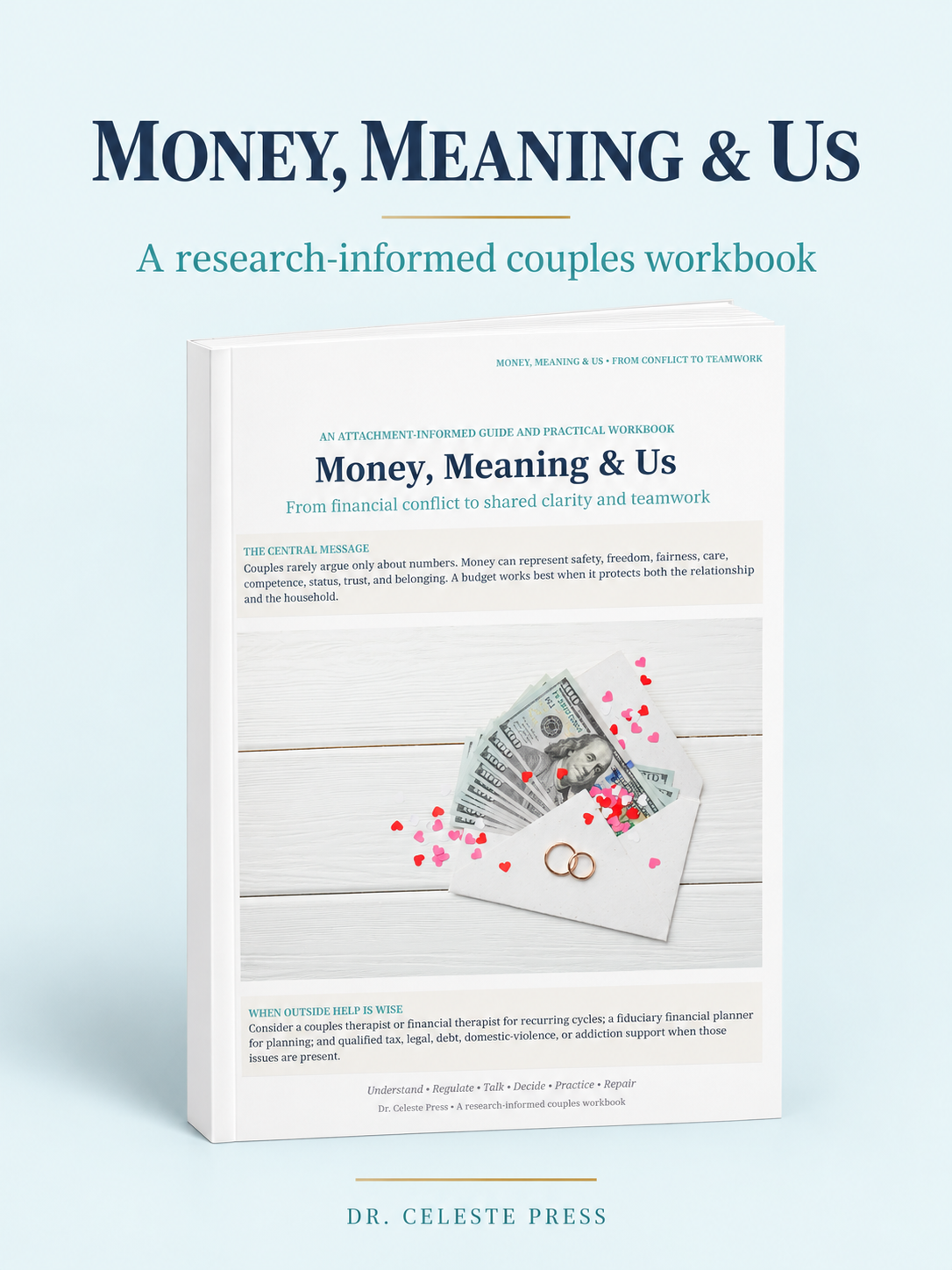
From Financial Conflict to Shared Clarity and Teamwork
Money disagreements are rarely only about numbers. Money can represent safety, freedom, fairness, care, competence, trust, status, and belonging.
Money, Meaning & Us is a 34-page, attachment-informed guide and practical couples workbook designed to help partners understand the emotions and relationship patterns beneath financial conflict. It provides structured conversations, practical worksheets, and flexible budgeting options that support both the relationship and the household.
Rather than treating one partner as the problem, this resource helps couples recognize the negative money cycle, understand each person’s history and protective responses, and work toward shared clarity, fairness, accountability, and teamwork.
WHAT’S INCLUDED
This 34-page workbook covers:
• Why money becomes emotional
• Financial socialization and family-of-origin money messages
• Unspoken expectations and implicit financial contracts
• Fear, shame, anger, grief, powerlessness, and resentment related to money
• An attachment-informed understanding of financial conflict
• Financial fairness, invisible labor, and the mental load
• Healthy transparency, autonomy, and financial safety
• Financial abuse and concerning controlling behaviors
• The negative money cycle
• Pursue-withdraw, control-rebellion, appeasement, and secrecy patterns
• Nervous-system regulation before financial conversations
• Structured listening and decision-making tools
• Values-based financial planning
• Combined, separate, hybrid, and partially pooled account structures
• Different approaches to sharing expenses fairly
• Conversation scripts for beginning difficult money discussions
• Guided conversations about money histories, fears, values, and goals
• Repair language for broken agreements or financial injuries
• A basic monthly household-budget worksheet
• Planning for irregular and annual expenses
• A combining-finances readiness worksheet
• A separate-finances shared-responsibility worksheet
• A joint-plus-separate finances worksheet
• A shared financial-goals worksheet
• A structured 30-minute monthly money-meeting agenda
• Research notes and recommendations for additional support
WHO THIS RESOURCE IS FOR
This workbook may be helpful for:
• Couples who repeatedly argue about spending, saving, debt, or financial responsibilities
• Partners who avoid financial conversations because they become tense or overwhelming
• Couples combining finances or reconsidering their current financial structure
• Partners who want a fairer division of financial labor and responsibility
• Couples working through different incomes, money histories, values, or definitions of fairness
• Partners wanting to create shared financial goals while preserving appropriate autonomy
• Couples seeking practical budgeting tools alongside relationship-focused guidance
• Therapists and financial therapists recommending educational resources to couples
FORMAT AND DELIVERY
• 34-page digital PDF workbook
• US Letter size
• Designed for viewing digitally or printing
• Includes educational content, guided conversations, scripts, reflection prompts, and practical worksheets
• Immediate digital download
• No physical product will be mailed
LICENSE AND PERMITTED USE
Your purchase includes a personal-use license for one individual or couple.
You may:
• Download and save the workbook for your personal use
• Print copies for yourself and your partner
• Complete and discuss the workbook within your partnership
• Reprint blank worksheets for your continued personal use
You may not:
• Resell, redistribute, forward, or publicly upload the workbook
• Share the complete file with friends, relatives, clients, colleagues, groups, or community members
• Post the workbook on a website, shared drive, membership platform, social-media page, or resource library
• Alter the workbook and present it as your own
• Remove the author’s name, branding, or copyright information
• Include any portion of the workbook in another product, course, training, or paid resource without written permission
Therapists and other professionals may recommend this workbook, but each client or couple should obtain their own copy unless a separate professional-use license has been granted.
DIGITAL-PRODUCT POLICY
Because this is an immediately accessible digital product, all sales are final. Digital products cannot be returned or exchanged after purchase or download.
If you experience a technical problem accessing the file, please use the website contact page for assistance.
EDUCATIONAL AND SAFETY DISCLAIMER
This workbook is intended for educational and informational purposes only. It does not constitute therapy, financial planning, investment guidance, tax advice, legal advice, debt counseling, diagnosis, crisis support, or domestic-violence intervention.
Financial abuse is not simply a communication problem. If money is being used to control, isolate, exploit, threaten, or endanger someone, individualized safety planning and qualified domestic-violence or legal support should take priority over joint budgeting conversations.
Couples experiencing recurring conflict may benefit from a couples therapist or financial therapist. Consult appropriately qualified financial, tax, legal, debt, addiction, or safety professionals when those concerns are present.
Created by Dr. Celeste Press
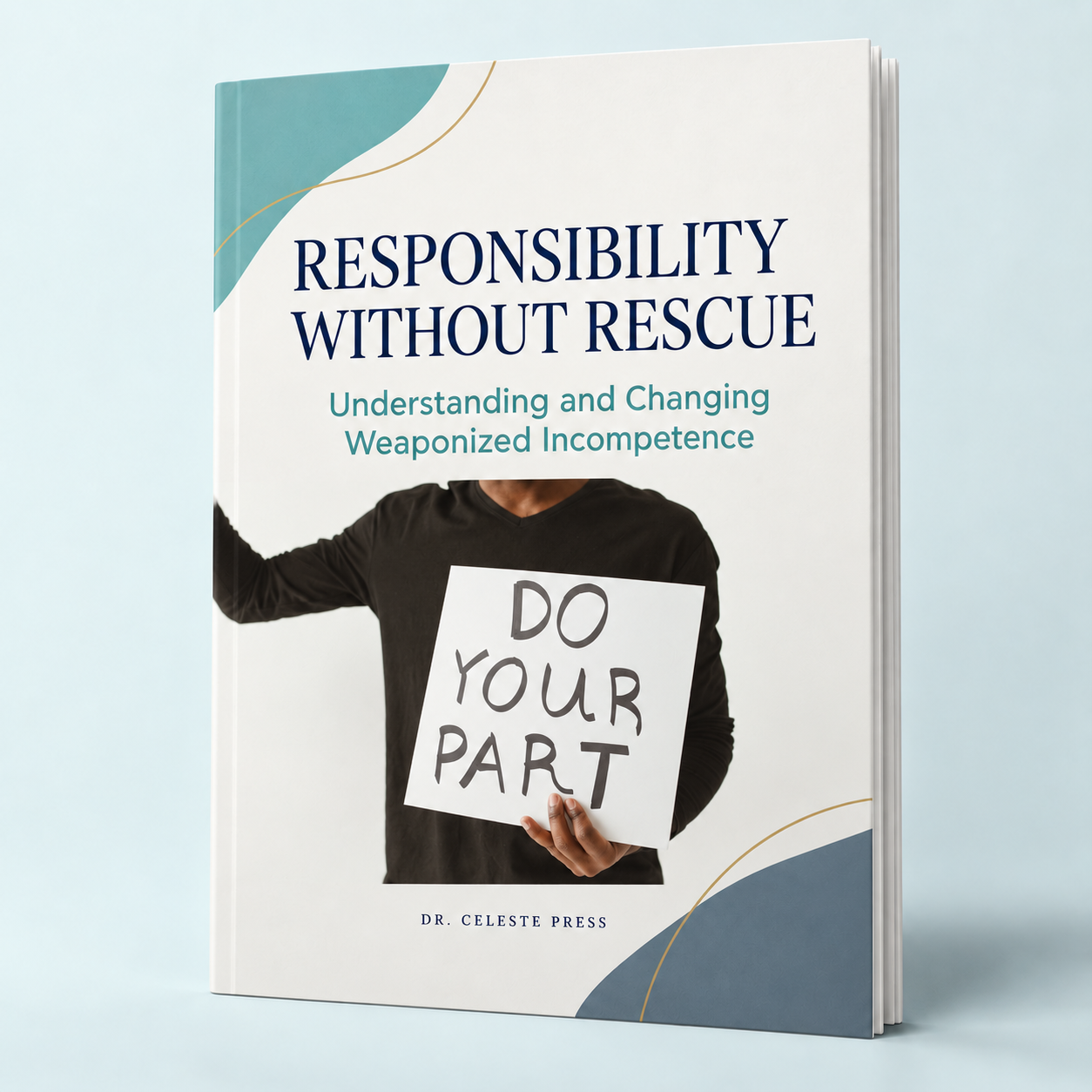
Understand how repeated helplessness, poor effort, avoidance, or incomplete follow-through can quietly transfer both responsibility and mental load to a partner.
Responsibility Without Rescue is a research-informed relationship guide to recognizing and changing patterns commonly described as weaponized incompetence.
The central question is straightforward: when a shared responsibility becomes difficult or unwanted, does the person who owns it learn, adapt, and follow through—or does the work migrate to their partner?
Using an attachment and Emotionally Focused Therapy lens, this guide helps couples distinguish genuine limitations or skill gaps from repeated responsibility-shifting. It also provides practical tools for creating clear ownership, supporting learning without taking over, and rebuilding fairness and dependability.
WHO THIS RESOURCE IS FOR
This guide may be especially helpful for:
• Couples struggling with unequal household or family responsibilities
• Partners carrying both visible tasks and invisible mental load
• People who feel more like a manager or parent than a partner
• Individuals wondering whether they may be underfunctioning or overfunctioning
• Couples affected by repeated forgetting, unfinished tasks, or failed agreements
• Partners navigating real differences in ability, capacity, experience, or executive functioning
• Couples working to restore fairness, trust, teamwork, and follow-through
• Therapists seeking a relationship-education recommendation for clients
WHAT IS WEAPONIZED INCOMPETENCE?
Weaponized incompetence is a popular, nonclinical term for a repeated pattern in which apparent inability, poor effort, avoidance, or helplessness shifts a responsibility—and the thinking required to manage it—onto someone else.
The behavior may or may not be consciously planned. This guide focuses on the repeated function, impact, accountability, capacity, and evidence of change rather than attempting to diagnose hidden motives.
WHAT YOU’LL LEARN
• How responsibility-shifting patterns develop
• The difference between a genuine skill gap and repeated avoidance
• Why one mistake or a different method does not establish weaponized incompetence
• How ADHD, disability, depression, trauma, pain, fatigue, cognitive changes, or cultural learning may affect performance
• Why accommodation should support equitable ownership rather than automatic exemption
• How to recognize the pattern in yourself without relying on shame
• How to observe repeated behavior in a partner without claiming to know intent
• Why invisible cognitive labor matters as much as the final visible task
• How unequal ownership can affect trust, desire, respect, rest, and connection
• How overfunctioning and underfunctioning reinforce each other
• How to support learning without becoming the manager
• How to create clearer agreements and evaluate follow-through over time
OWNERSHIP FROM BEGINNING TO END
The guide explains that ownership includes more than completing the final step. Genuine ownership may involve:
• Noticing or anticipating the need
• Planning what must happen
• Gathering information and resources
• Completing the task
• Communicating with affected people
• Monitoring progress and deadlines
• Correcting problems and repairing mistakes
PRACTICAL TOOLS
The booklet includes:
• A genuine-skill-gap versus responsibility-shifting comparison
• A personal self-check for underfunctioning patterns
• Indicators for observing repeated behavior in a partner
• An explanation of visible and invisible cognitive labor
• An attachment-based overfunctioning and underfunctioning cycle
• A five-step process for addressing the pattern directly
• Strategies for supporting without taking over
• Replacement language for common helpless or defensive responses
• A responsible apology script
• A boundary script for the overfunctioning partner
• A Two-Week Responsibility Reset worksheet
• Selected peer-reviewed research
FAIRNESS AND CAPACITY
Fairness does not always mean dividing every task equally. Capacity can change because of illness, disability, pregnancy, work demands, grief, caregiving, pain, or other circumstances.
A fair arrangement is explicit, collaborative, responsive, and open to revision. Real limitations may change how a task is completed or how labor is divided. Healthy adaptation still includes honesty, reliable systems, communication, and ownership of an equitable share.
IMPORTANT SAFETY INFORMATION
Do not allow children, pets, health, housing, finances, or physical safety to be harmed in order to create a natural consequence or teach someone a lesson.
If requests for equitable participation lead to intimidation, financial control, threats, stalking, sexual pressure, retaliation, or violence, the problem is more than an unequal-chore pattern. Seek confidential individual and safety support. Joint therapy may not be appropriate until safety has been assessed.
FORMAT AND DELIVERY
This is a digital product. No physical product will be shipped.
File format: PDF
Length: 14 pages
Page size: US Letter
Designed for: Digital reading or printing
After completing your purchase, follow the provided download instructions and save a copy to your device.
EDUCATIONAL INFORMATION
Weaponized incompetence is a popular descriptive term, not a clinical diagnosis. Direct peer-reviewed research using that exact phrase remains limited. This guide draws from research on household labor, cognitive labor, perceived fairness, attachment, responsiveness, and couple well-being.
This resource provides general relationship education and is not a substitute for individualized psychotherapy, medical care, disability assessment, legal guidance, safety planning, or emergency services.
LICENSE AND PERMITTED USE
Your purchase includes a license for individual or relationship use. You may save a copy, print the guide for yourself, and share it with your partner for use within your relationship.
Please do not share the complete file with friends, colleagues, clients, groups, or your broader community. Instead, share the original Hub Library product link so others can obtain their own licensed copy.
The guide may not be resold, redistributed, republished, uploaded to a shared resource library, altered and presented as another person’s work, or used as a handout for multiple clients without written permission.
DIGITAL-PRODUCT POLICY
Because this digital product is delivered electronically, all sales are final. If you experience a technical problem accessing your purchase, please contact us for assistance.
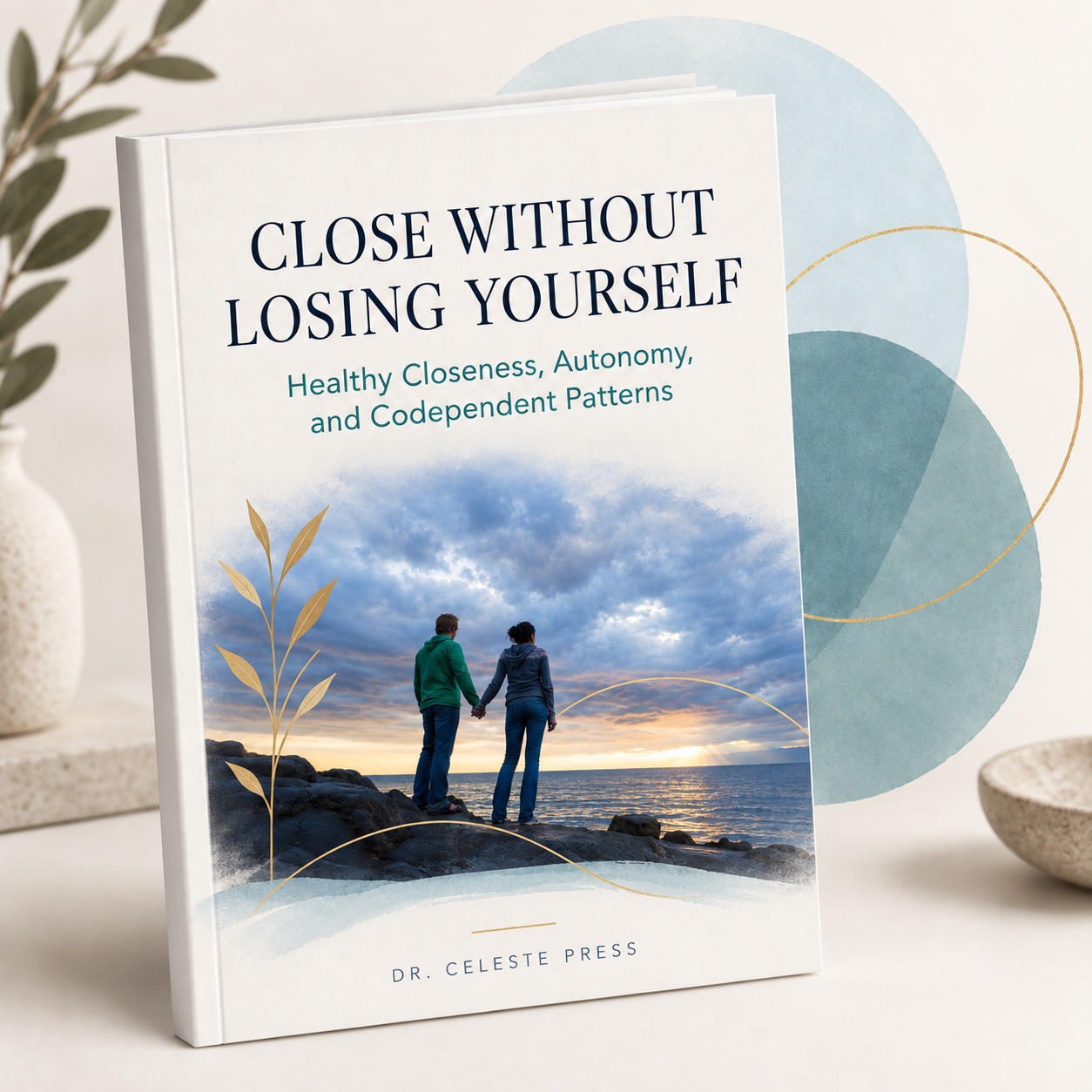
Enjoy closeness, support, and healthy dependence without giving up your voice, identity, boundaries, or sense of self.
Close Without Losing Yourself is a research-informed relationship guide exploring the differences among healthy dependence, interdependence, hyper-independence, enmeshment, and codependent patterns.
Using an attachment and Emotionally Focused Therapy lens, this resource helps readers look beyond labels and understand the function of relationship behaviors. It offers reassurance that enjoying your partner, needing comfort, and spending significant time together are not automatically signs of codependency.
The central question is not simply how much two people depend on each other. It is whether closeness includes choice, reciprocity, responsibility, safety, and room for both people to remain themselves.
WHO THIS RESOURCE IS FOR
This guide may be especially helpful for:
• Individuals wondering whether their relationship is close or codependent
• Couples who spend significant time together and want to protect healthy autonomy
• People who frequently overfunction, rescue, fix, or take responsibility for a partner
• People who struggle to express preferences, needs, or boundaries
• Partners working to balance connection and individuality
• Readers exploring attachment, enmeshment, or hyper-independence
• Therapists seeking a relationship-education recommendation for clients
WHAT YOU’LL LEARN
• Why enjoying your partner’s company is not automatically codependency
• How to evaluate the function and impact of relationship behaviors
• Why codependency is better understood as a pattern than a diagnosis
• The differences among dependence, interdependence, hyper-independence, enmeshment, and codependent patterns
• Signs that closeness may be costing you your identity, goals, relationships, health, or safety
• How autonomy and differentiation can strengthen intimacy
• How attachment fears can fuel pursuing, fixing, rescuing, pleasing, withdrawing, or overfunctioning
• How to support a partner without taking over their responsibilities
• How to create closeness that still allows each person to have a voice and a self
WHAT’S INCLUDED
• A relationship continuum comparing five patterns of connection
• Examples of healthy, concerning, and harmful relationship behaviors
• Signs that you may be losing yourself in a relationship
• An attachment and EFT-based explanation of protective relationship cycles
• Scripts for requesting separate time while preserving connection
• Scripts for supporting a partner without taking control
• Boundary-setting and reconnection language
• Guidance for repairing overfunctioning
• A brief relationship self-check
• Small experiments for strengthening autonomy and connection
• Research references and recommendations for seeking additional support
IMPORTANT SAFETY DISTINCTION
Codependent or overfunctioning patterns should not be used to explain away abuse.
If a partner intimidates, coerces, stalks, isolates, threatens, monitors, retaliates, or controls access to resources, the concern is safety—not simply a mutual attachment cycle. Individual support, specialized domestic-violence resources, and safety planning should come before couples exercises.
FORMAT AND DELIVERY
This is a digital product. No physical product will be shipped.
File format: PDF
Length: 12 pages
Page size: US Letter
Designed for: Digital reading or printing
After completing your purchase, follow the provided download instructions and save a copy to your device.
EDUCATIONAL INFORMATION
This guide provides general relationship education. It is not a diagnosis and does not replace individualized psychotherapy, medical care, legal guidance, domestic-violence services, or emergency support.
An attachment- or EFT-informed couples therapist may be helpful when the pattern is entrenched and both partners can participate safely. Seek individual or specialized support when fear, coercion, threats, surveillance, or retaliation are present.
LICENSE AND PERMITTED USE
Your purchase includes a license for individual or relationship use. You may save a copy, print the guide for yourself, and share it with your partner for use within your relationship.
Please do not share the complete file with friends, colleagues, clients, groups, or your broader community. Instead, share the original Hub Library product link so others can obtain their own licensed copy.
The guide may not be resold, redistributed, republished, uploaded to a shared resource library, altered and presented as another person’s work, or used as a handout for multiple clients without written permission.
DIGITAL-PRODUCT POLICY
Because this digital product is delivered electronically, all sales are final. If you experience a technical problem accessing your purchase, please contact us for assistance.
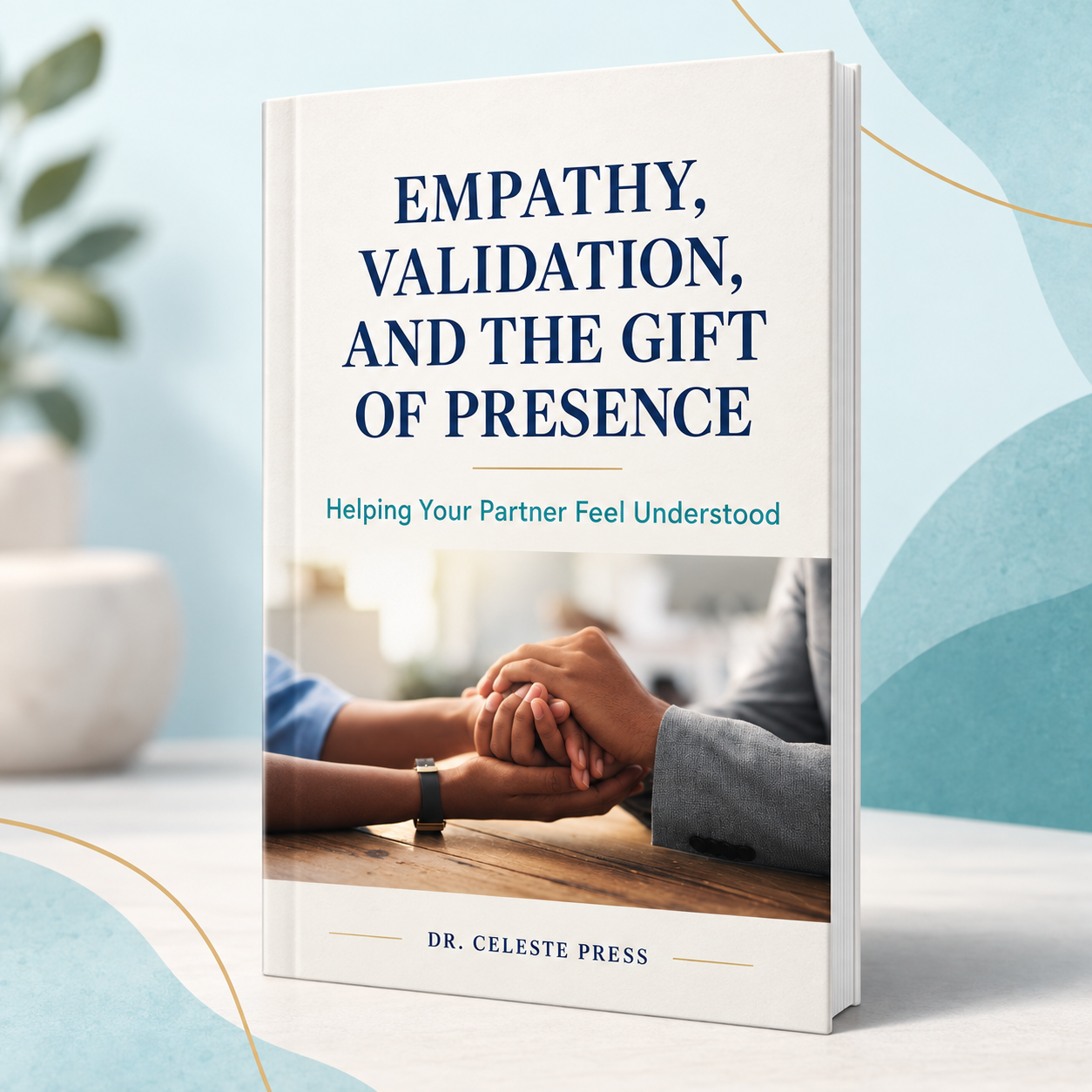
Learn how to help your partner feel understood before moving into advice, solutions, or action.
Empathy, Validation, and the Gift of Presence is a research-informed relationship guide for couples who want to respond to difficult emotions with greater warmth, understanding, and connection.
Using an attachment and Emotionally Focused Therapy lens, this booklet explains the differences among empathy, validation, compassion, and problem-solving. It offers a practical process for recognizing what a partner needs, staying present with emotion, validating without automatically agreeing, and asking before offering advice.
The goal is not perfect communication or making difficult feelings disappear. The goal is helping each person feel less alone inside the emotional experience.
WHO THIS RESOURCE IS FOR
This guide may be especially helpful for:
• Couples who frequently move into advice before understanding
• Partners who want to become better emotional listeners
• People who feel helpless or uncomfortable around strong emotions
• Couples who become caught in fixing, defending, minimizing, or withdrawing
• People who struggle to express what kind of support they need
• Partners learning how to validate without abandoning boundaries
• Therapists seeking a relationship-education recommendation for clients
WHAT YOU’LL LEARN
• The differences among empathy, validation, compassion, and problem-solving
• Why validation does not require agreement
• How validation responds to attachment needs for accessibility, responsiveness, and engagement
• Why connection often needs to come before correction
• How uninvited problem-solving can unintentionally create disconnection
• How to ask what kind of support a partner wants
• What it means to sit with emotion without trying to erase it
• How the listener’s own attachment alarm can interfere with presence
• How to regulate yourself without emotionally abandoning your partner
• How to validate emotion while maintaining accountability and behavioral limits
• How to repair a moment of invalidation
THE N.U.R.S.E. PROCESS
The booklet introduces a repeatable five-step response.
PRACTICAL SCRIPTS AND EXAMPLES
The guide includes language for:
• Responding when a partner feels overwhelmed
• Staying present with anger or grief
• Offering attachment reassurance
• Holding two different memories of an event
• Replacing invalidating responses with more connecting language
• Asking before advising
• Taking a regulated pause and returning as promised
• Validating emotion without accepting insults, threats, or aggression
• Repairing when you moved into solutions too quickly
• Telling your partner that you need understanding before ideas
WHAT’S INCLUDED
• Definitions and comparisons
• Attachment and EFT-informed education
• The N.U.R.S.E. emotional-support process
• Two sections of practical relationship scripts
• A five-part repair process
• Guidance for healthy boundaries and limits
• A five-minute presence exercise for couples
• A couple worksheet for building a personalized support map
• Selected peer-reviewed research
FORMAT AND DELIVERY
This is a digital product. No physical product will be shipped.
File format: PDF
Length: 19 pages
Page size: US Letter
Designed for: Digital reading or printing
After completing your purchase, follow the provided download instructions and save a copy to your device.
IMPORTANT INFORMATION
Validation does not mean agreeing with every interpretation, accepting blame that is not yours, approving harmful behavior, or abandoning boundaries and accountability.
Presence does not replace medical care, safety intervention, accountability, or necessary practical action. Emotional openness should not be encouraged when disclosures are likely to be mocked, punished, exposed, coerced, or used as leverage.
This guide provides general relationship education. It is not a substitute for individualized psychotherapy, medical care, diagnosis, treatment, safety planning, or emergency services.
LICENSE AND PERMITTED USE
Your purchase includes a license for individual or relationship use. You may save a copy, print the guide for yourself, and share it with your partner for use within your relationship.
Please do not share the complete file with friends, colleagues, clients, groups, or your broader community. Instead, share the original Hub Library product link so others can obtain their own licensed copy.
The guide may not be resold, redistributed, republished, uploaded to a shared resource library, altered and presented as another person’s work, or used as a handout for multiple clients without written permission.
DIGITAL-PRODUCT POLICY
Because this digital product is delivered electronically, all sales are final. If you experience a technical problem accessing your purchase, please contact us for assistance.
Handouts
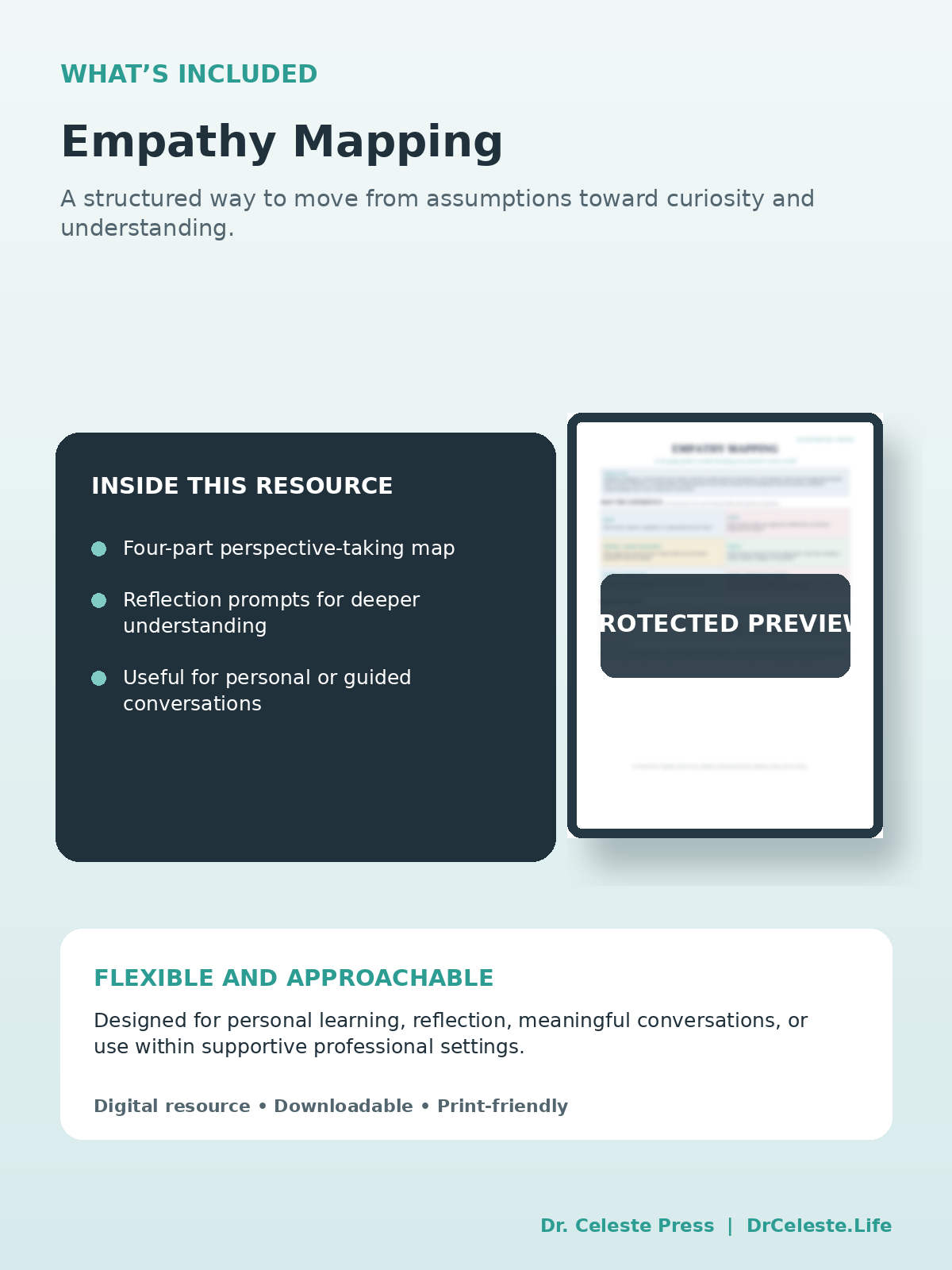
Empathy begins with slowing down long enough to become curious about another person’s experience.
Empathy Mapping is a one-page relationship tool that helps partners move away from immediate reactions and assumptions and toward greater emotional understanding. It provides a structured way to consider what may be happening beneath a partner’s words, behaviors, and protective responses.
Rather than attempting to read someone’s mind, the empathy map encourages users to observe, wonder, ask, listen, and invite correction. The goal is to help a partner feel accurately known before moving into advice, explanation, or problem-solving.
WHAT YOU’LL LEARN
• What empathy mapping is and how it supports emotional connection
• How to separate observable facts from personal interpretations
• How to replace assumptions with curiosity
• How to explore what an experience may mean to another person
• How attachment fears may shape a partner’s reactions
• How to notice the emotions, needs, fears, and longings beneath protective behavior
• Why empathy does not require agreement
• Why understanding another person does not excuse harmful behavior
• How validation can come before advice or problem-solving
WHAT’S INCLUDED
The one-page empathy map guides you through six areas of your partner’s possible inner experience:
The handout also includes:
• A five-step process for using empathy mapping effectively
• Reminders to treat interpretations as questions rather than facts
• A ready-to-use relationship check-in script
• Guidance for asking whether a partner wants listening, comfort, help, or ideas
WHO THIS RESOURCE IS FOR
This handout may be helpful for:
• Couples who want to understand each other more clearly
• Partners who frequently become stuck in assumptions or misunderstandings
• Individuals learning how to listen before explaining, fixing, or defending
• People who want to respond more effectively to a partner’s emotional experience
• Couples practicing empathy, validation, emotional accessibility, and secure connection
• Individuals completing relationship work independently or with a partner
• Therapists and helping professionals seeking a concise educational tool for their own professional learning
Empathy mapping is most useful when both people can communicate freely and safely. It should not be used to excuse abuse, demand emotional access, pressure someone into vulnerability, or make one person responsible for continually understanding harmful behavior.
FORMAT AND DELIVERY
• One-page digital PDF handout
• Standard US Letter size: 8.5 × 11 inches
• Designed for convenient viewing on a computer, tablet, or mobile device
• May be printed for the purchaser’s permitted individual use
• Delivered electronically as an instant digital download after purchase
This is a digital product. No physical product will be shipped.
EDUCATIONAL INFORMATION
This handout is intended for educational and reflective purposes only. It is not a diagnostic instrument and is not a substitute for individualized mental-health care, relationship assessment, crisis support, or safety planning.
An empathy map represents a hypothesis—not mind-reading, agreement, diagnosis, or proof of another person’s emotions or intentions. Users should invite correction and allow the other person to describe their own experience.
Empathy and validation do not require anyone to accept mistreatment, abandon boundaries, or excuse harmful behavior. When fear, coercion, intimidation, abuse, or retaliation is present, safety and specialized professional support should take priority over increased vulnerability.
LICENSE AND PERMITTED USE
Your purchase includes an individual-use license.
You may:
• Download and save the PDF for your own use
• View the handout on your personal devices
• Print copies for your own personal use
• Review and complete the handout with your partner when appropriate and safe
You may not:
• Share the digital file with friends, colleagues, clients, supervisees, groups, or organizations
• Email, upload, copy, or distribute the PDF to others
• Place the resource in a shared drive, shared library, membership platform, course, or resource collection
• Print or distribute copies as multi-client handouts
• Reproduce, modify, republish, translate, rebrand, sell, or resell any portion of the resource
• Remove the Dr. Celeste Press name, copyright notice, or other identifying information
Each individual or professional who wants a copy must purchase their own licensed copy unless separate written permission or an organizational license has been obtained from Dr. Celeste Press.
DIGITAL-PRODUCT POLICY
Because this digital product is delivered electronically, all sales are final. If you experience a technical problem accessing your purchase, please contact us for assistance.
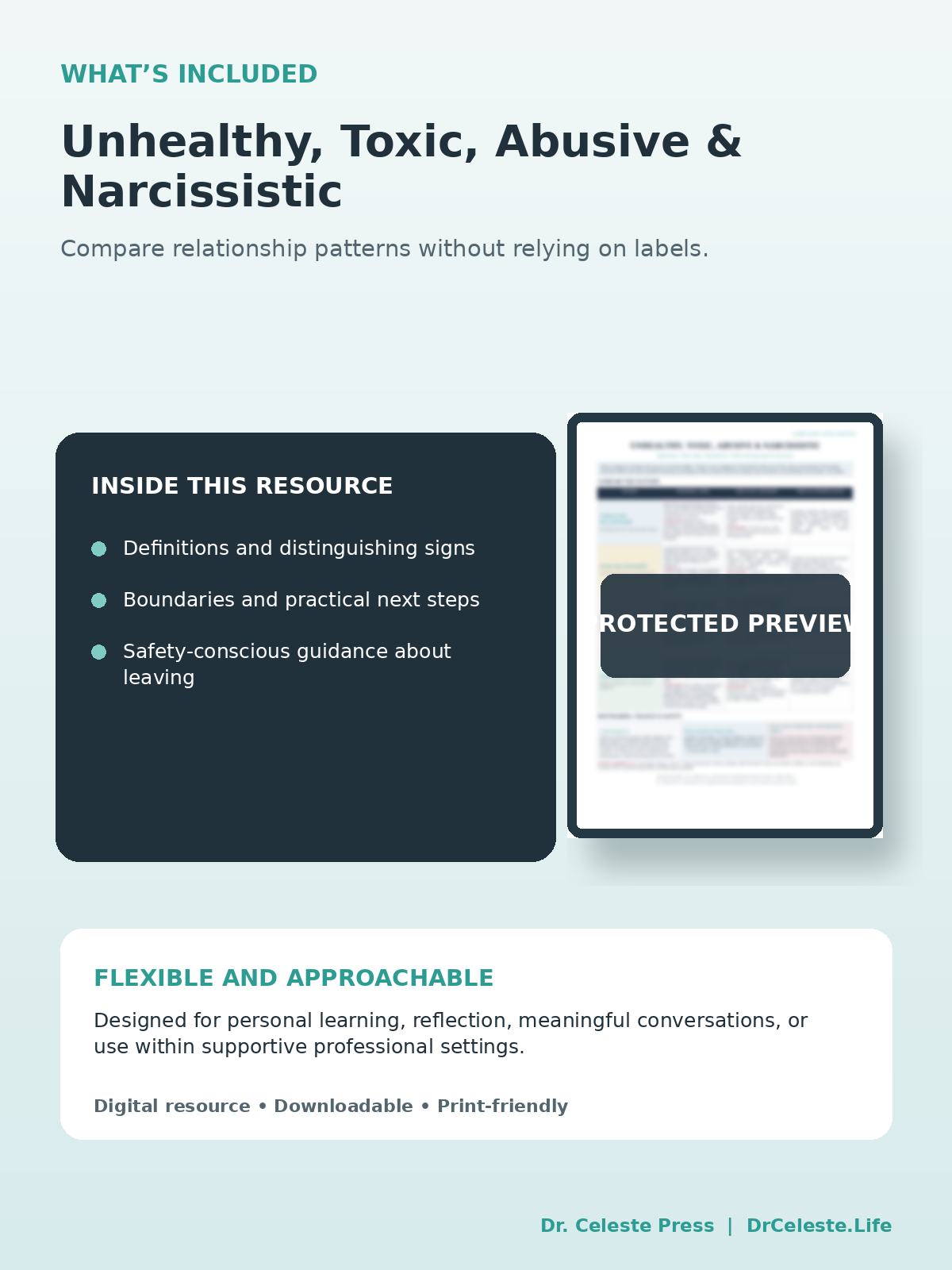
A safety-conscious, one-page comparison of unhealthy, toxic, abusive, and narcissistic relationship patterns. Learn how these patterns differ, what warning signs to notice, which boundaries may help, and when leaving or seeking specialized support may be necessary.
Full product description
Gain clarity about harmful relationship patterns without relying on misleading labels or oversimplified advice.
Words such as unhealthy, toxic, abusive, and narcissistic are often used interchangeably, but they do not mean the same thing. These categories can overlap, and they should not be treated as a simple severity ladder.
This one-page, safety-conscious guide compares observable behaviors, effects, accountability, fear, freedom, and patterns of change. It also explains that “toxic” is not a clinical diagnosis and that narcissistic traits are not the same as Narcissistic Personality Disorder.
WHAT’S INCLUDED
This one-page comparison covers:
Unhealthy relationship patterns
Toxic relationship dynamics
Abusive relationships involving power, control, intimidation, or coercion
Narcissistic traits and relationship dynamics
Definitions and warning signs for each pattern
Recommended next steps
Examples of clear, actionable boundaries
Indicators that leaving may be necessary
What genuine and sustained change looks like
When to leave or end a harmful conversation
U.S. domestic-violence safety resources
WHAT THIS RESOURCE HELPS EXPLAIN
The guide helps readers distinguish between:
Relationship problems that may be repairable
Chronic dynamics that damage dignity, trust, identity, or well-being
Patterns of coercion, intimidation, surveillance, threats, or violence
Narcissistic traits versus a clinical diagnosis
Apologies and temporary improvement versus sustained change
Boundaries that protect the individual versus attempts to control another person
Couples therapy concerns when someone cannot speak freely or safely
WHO THIS RESOURCE IS FOR
This resource may be helpful for:
Individuals questioning whether a relationship pattern is unhealthy or harmful
People learning to recognize coercive or abusive behavior
Individuals working to establish clearer boundaries
Therapists, counselors, supervisors, educators, and helping professionals
Clients exploring relationship safety, accountability, and repair
Anyone seeking a concise and safety-conscious relationship reference
FORMAT AND DELIVERY
One-page digital PDF
US Letter size
Designed for viewing on a device or printing
Immediate digital download
No physical product will be mailed
LICENSE AND PERMITTED USE
Your purchase includes a single-user license.
You may:
Download and save the resource for your own use
Print copies for your personal use
Use the resource with your own therapy or supervision clients
Provide a printed or digital copy to an individual client for educational use
You may not:
Resell, redistribute, share, or upload the resource publicly
Post the complete resource on a website, shared drive, social-media page, membership platform, or resource library
Alter the resource and present it as your own
Remove the author’s name, branding, or copyright information
Include it in another product, training, course, or paid resource without written permission
Organizations, group practices, training programs, and agencies should obtain permission before distributing the resource across multiple professionals or departments.
DIGITAL-PRODUCT POLICY
Because this is an immediately accessible digital product, all sales are final. Digital products cannot be returned or exchanged after purchase or download. If you experience a technical problem accessing the file, please use the website contact page for assistance.
EDUCATIONAL AND SAFETY DISCLAIMER
This resource is intended for educational and informational purposes only. It is not a diagnosis or a substitute for individualized mental-health, medical, legal, emergency, or safety services.
Attachment patterns may help explain protective behavior, but they never excuse coercion or abuse. Someone does not need to wait for physical violence before seeking help or leaving an unsafe relationship. When monitoring or retaliation may be present, consider device and browsing safety when accessing support.
Created by Dr. Celeste Press
Education
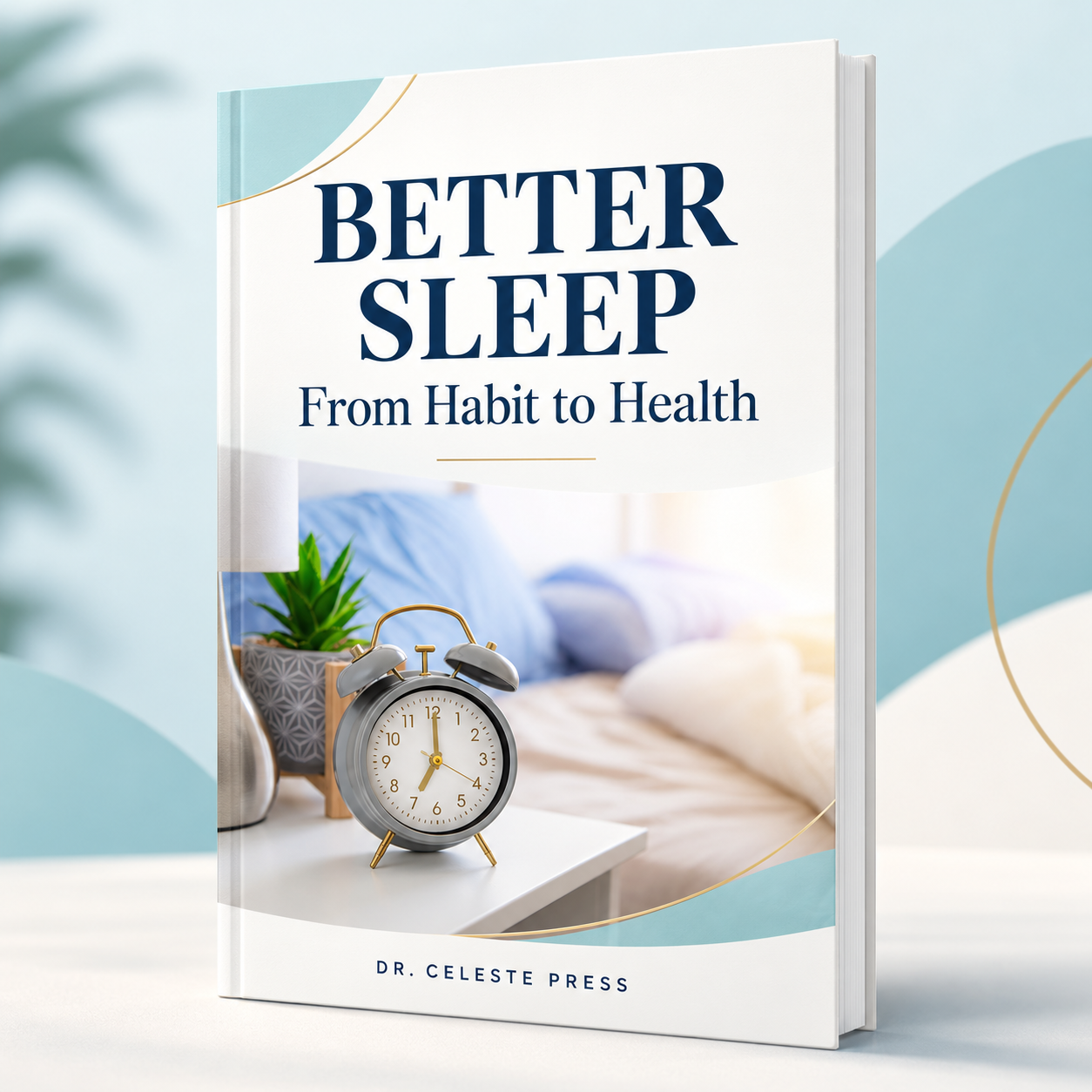
Sleep is about more than following a list of bedtime rules. This research-informed guide helps adults understand the difference between sleep hygiene—the routines and conditions that support sleep—and sleep health—the overall functioning of the sleep-wake system.
Better Sleep: From Habit to Health provides realistic strategies for strengthening sleep patterns without demanding a perfect routine. Readers are encouraged to observe their individual patterns, select manageable changes, and evaluate how sleep affects their daytime functioning and overall well-being.
The booklet includes:
• The difference between sleep hygiene and sleep health
• A practical morning-to-night approach to supporting sleep
• Strategies for recovering after a difficult night
• Sleep hygiene and sleep health baseline checklists
• A personalized sleep-change planning worksheet
• A gentle five-phase approach to building healthier patterns
• Signs that professional evaluation may be appropriate
• A one-page personal review and action plan
• Research notes and supporting resources
WHO THIS RESOURCE IS FOR
This guide may be especially helpful for:
adults who want to better understand their sleep, improve supportive routines, and recognize when sleep difficulties may require professional assessment.
FORMAT AND DELIVERY
This is a digital product. No physical product will be shipped.
File format: PDF
Length: 16 pages
Page size: US Letter
Designed for: Digital reading or printing
After completing your purchase, follow the provided download instructions and save a copy to your device.
EDUCATIONAL INFORMATION
This resource is educational and is not a substitute for individualized medical care, diagnosis, or treatment.
LICENSE AND PERMITTED USE
Your purchase includes a license for individual or relationship use. You may save a copy, print the guide for yourself, and share it with your partner for use within your relationship.
Please do not share the complete file with friends, colleagues, clients, groups, or your broader community. Instead, share the original Hub Library product link so others can obtain their own licensed copy.
The guide may not be resold, redistributed, republished, uploaded to a shared resource library, altered and presented as another person’s work, or used as a handout for multiple clients without written permission.
DIGITAL-PRODUCT POLICY
Because this digital product is delivered electronically, all sales are final. If you experience a technical problem accessing your purchase, please contact us for assistance.
Booklets
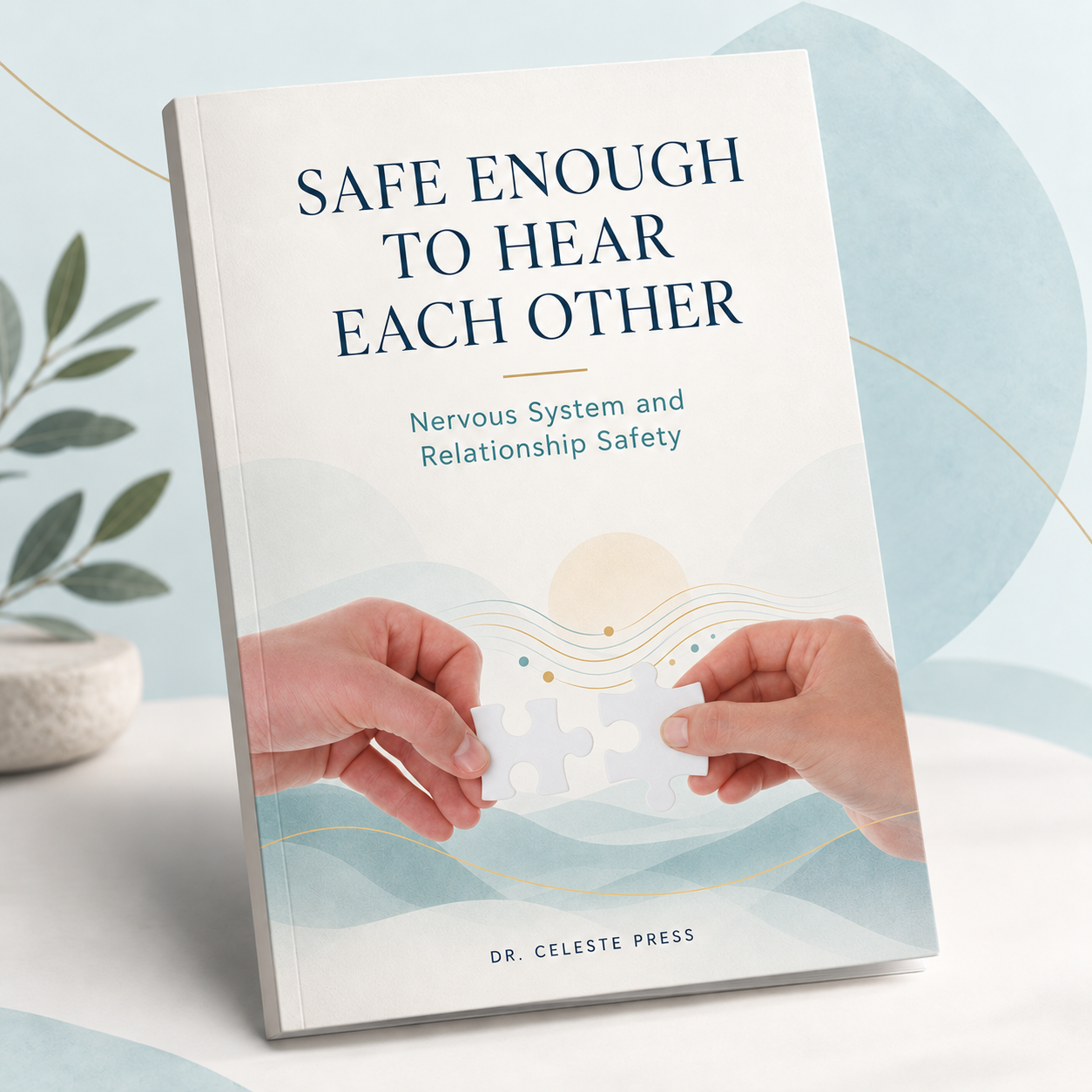
Understand how nervous-system activation can shape conflict, connection, listening, feedback, and repair within relationships.
Safe Enough to Hear Each Other is a research-informed relationship guide exploring the autonomic nervous system, attachment alarm, co-regulation, and the repeated experiences that help partners feel safer with each other.
When the body expects threat, feedback may sound like attack, distance may feel like abandonment, and emotion may feel dangerous. When the relationship feels safer, the same information may be heard with greater curiosity and flexibility.
Using an attachment and Emotionally Focused Therapy lens, this booklet helps couples recognize activation without using nervous-system language to diagnose, excuse harmful behavior, or silence emotion.
WHO THIS RESOURCE IS FOR
This guide may be especially helpful for:
• Couples who become overwhelmed, defensive, shut down, or reactive during conflict
• Partners caught in pursue-withdraw patterns
• People who struggle to listen when emotions become intense
• Couples learning how to pause without creating abandonment or punishment
• Partners who want to understand co-regulation without becoming responsible for each other’s emotions
• People who want to make feedback feel safer and more productive
• Therapists seeking a relationship-education recommendation for clients
WHAT YOU’LL LEARN
• What the autonomic nervous system does
• The general roles of sympathetic and parasympathetic activity
• How stress can affect attention, memory, flexibility, and communication
• Signs of high mobilization and low-energy protection
• Why the same words can feel safe in one context and attacking in another
• How attachment alarm can recruit both partners’ nervous systems
• How pursuing, defending, freezing, minimizing, and withdrawing can reinforce a relationship cycle
• What relational safety means beyond simply remaining calm
• How accessibility, responsiveness, and engagement create cues of connection
• How to remain in your partner’s inner world before explaining your own
• How validation and presence can support regulation
• How to offer co-regulation without taking control
• How to make difficult feedback easier to hear
• How to pause, return, and repair dependably
RELATIONSHIP SAFETY
The guide explains that a safe relationship is not necessarily conflict-free. Relational safety grows when both people can:
• Express emotion and honest feedback
• Maintain boundaries and autonomy
• Make mistakes and attempt repair
• Say no without retaliation
• Expect agreements and return times to be dependable
• Experience respect, consent, reciprocity, and accountability
• Remain separate people without humiliation, coercion, or abandonment games
PRACTICAL TOOLS
The booklet includes:
• Comparisons of regulated capacity, high mobilization, and low-energy protection
• Examples of how common relationship phrases can land differently
• The attachment-based pursue-withdraw cycle
• Accessibility, responsiveness, and engagement practices
• A menu of possible co-regulation supports
• A structure for giving difficult feedback
• A dependable pause-and-return script
• A five-step repair process
• A Couple Safety Plan worksheet
• Selected peer-reviewed research
IMPORTANT DISTINCTIONS
Nervous-system activation can explain urgency or protective behavior, but it does not excuse threats, intimidation, coercion, cruelty, aggression, or violence.
A calm presentation does not prove that someone is correct or safe. Strong emotion does not prove that someone is irrational or dangerous. Evaluate observable behavior, consent, truthfulness, power, impact, and patterns—not only tone or body language.
Nervous-system concepts should not be used to silence a partner with statements such as “calm down” or “you are dysregulated.” Regulation should increase a person’s capacity for choice and connection, not require emotional obedience.
FORMAT AND DELIVERY
This is a digital product. No physical product will be shipped.
File format: PDF
Length: 18 pages
Page size: US Letter
Designed for: Digital reading or printing
After completing your purchase, follow the provided download instructions and save a copy to your device.
EDUCATIONAL INFORMATION
This guide translates broad research into client-friendly education. It is not a physiological assessment, diagnosis, or substitute for individualized medical care, psychotherapy, trauma treatment, safety planning, or emergency services.
Autonomic responses are influenced by many factors and cannot independently reveal a person’s intentions, truthfulness, diagnosis, or the safety of a relationship.
LICENSE AND PERMITTED USE
Your purchase includes a license for individual or relationship use. You may save a copy, print the guide for yourself, and share it with your partner for use within your relationship.
Please do not share the complete file with friends, colleagues, clients, groups, or your broader community. Instead, share the original Hub Library product link so others can obtain their own licensed copy.
The guide may not be resold, redistributed, republished, uploaded to a shared resource library, altered and presented as another person’s work, or used as a handout for multiple clients without written permission.
DIGITAL-PRODUCT POLICY
Because this digital product is delivered electronically, all sales are final. If you experience a technical problem accessing your purchase, please contact us for assistance.
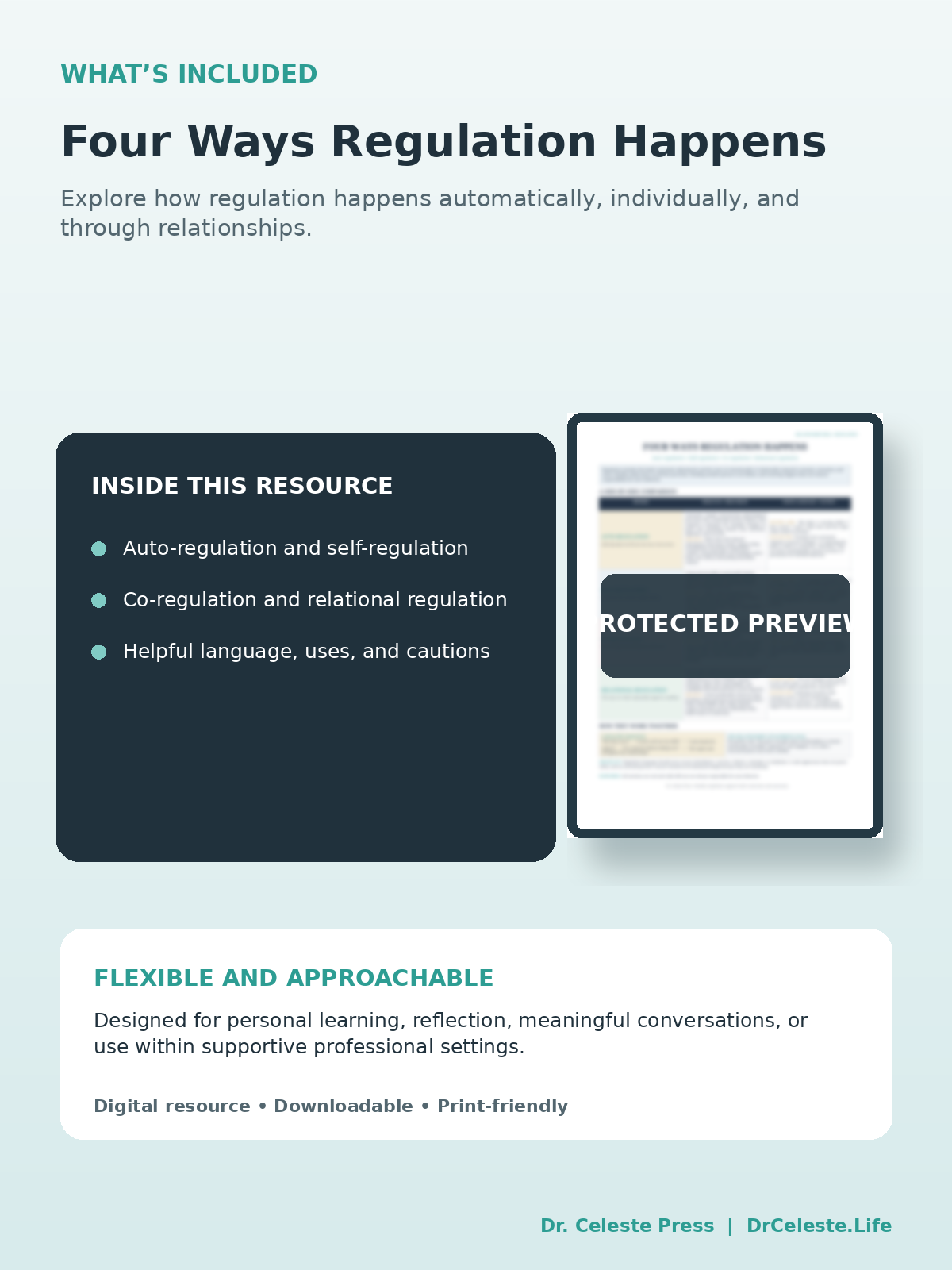
Understand how regulation happens within the body, within yourself, with another person, and through dependable relationships.
Regulation is more than calming yourself down. It includes the body’s automatic adjustments, the skills you intentionally use, the support you receive from others, and the patterns of safety and repair created within relationships.
This one-page comparison explains four important regulation processes through an attachment- and Emotionally Focused Therapy-informed lens. It reinforces that healthy adults use all four forms of regulation—and that needing support does not mean failure or remove responsibility for one’s behavior.
WHAT’S INCLUDED
This one-page reference compares:
Auto-regulation
Self-regulation
Co-regulation
Relational regulation
What each regulation method means
Helpful strategies for supporting each method
Example language for communicating needs
Common misunderstandings and concerns to watch for
How all four regulation processes work together
The attachment- and EFT-informed goal of flexible, responsive engagement
WHO THIS RESOURCE IS FOR
This resource may be helpful for:
Individuals wanting to better understand their emotional and physiological responses
Couples working toward safer and more responsive communication
People learning how to ask for support without giving up personal responsibility
Therapists, counselors, supervisors, educators, and helping professionals
Clients learning about attachment, emotional regulation, boundaries, and relationship repair
Anyone wanting a concise reference for personal reflection or educational use
FORMAT AND DELIVERY
One-page digital PDF
US Letter size
Designed for viewing on a device or printing
Immediate digital download
No physical product will be mailed
LICENSE AND PERMITTED USE
Your purchase includes a single-user license.
You may:
Download and save the resource for your own use
Print copies for your personal use
Use the resource with your own therapy or supervision clients
Provide a printed or digital copy to an individual client for educational use
You may not:
Resell, redistribute, share, or upload the resource publicly
Post the complete resource on a website, shared drive, social-media page, membership platform, or resource library
Alter the resource and present it as your own
Remove the author’s name, branding, or copyright information
Include it in another product, training, course, or paid resource without written permission
Organizations, group practices, training programs, and agencies should obtain permission before distributing the resource across multiple professionals or departments.
DIGITAL-PRODUCT POLICY
Because this is an immediately accessible digital product, all sales are final. Digital products cannot be returned or exchanged after purchase or download. If you experience a technical problem accessing the file, please use the website contact page for assistance.
EDUCATIONAL DISCLAIMER
This resource is intended for educational and informational purposes only. It is not therapy, medical care, diagnosis, crisis support, or a substitute for individualized professional services.
Regulation language should never be used to excuse intimidation, coercion, violence, contempt, retaliation, or other harmful behavior. A calm appearance does not necessarily indicate safety, and emotional activation does not make a person’s concerns invalid.
Handouts

Understand what your nervous system is doing—and choose support that fits the moment.
Your Nervous System at a Glance is a clear, client-friendly reference that explains the major parts of the nervous system and how they support thought, movement, sensation, automatic body functions, digestion, activation, restoration, and recovery.
The handout also provides practical skills for moments of high activation, shutdown, disconnection, and relational stress.
Rather than presenting calm as the only healthy state, this resource emphasizes nervous-system flexibility: the ability to mobilize when needed, rest and restore, respond to the environment, connect with others, and recover after stress.
WHAT’S INCLUDED
• One-page nervous-system map
• Central Nervous System overview
• Peripheral Nervous System overview
• Somatic Nervous System overview
• Autonomic Nervous System overview
• Sympathetic branch explanation
• Parasympathetic branch explanation
• Enteric nervous system explanation
• Regulation skills for high activation
• Regulation skills for shutdown or very low energy
• Everyday resilience practices
• Co-regulation and relational-safety strategies
• Important reminders about nervous-system language and interpretation
WHAT THIS RESOURCE HELPS EXPLAIN
The handout provides accessible descriptions of:
• The brain and spinal cord as the body’s command-and-integration center
• The peripheral nerves as the communication network between the body and brain
• The somatic nervous system’s role in sensation and voluntary action
• The autonomic nervous system’s role in automatic body regulation
• Sympathetic activation and mobilization
• Parasympathetic restoration, digestion, and recovery
• The enteric nervous system’s role in digestive coordination
• Why activation is not automatically harmful
• Why parasympathetic activity does not always mean calm
• Why the goal is flexibility and recovery rather than remaining calm all the time
REGULATION SKILLS INCLUDED
For high activation
For shutdown or very low energy
For relationships
WHO THIS RESOURCE IS FOR
This handout may be helpful for:
• Therapists and counselors
• Clinical social workers
• Marriage and family therapists
• Mental health counselors
• Psychologists and other helping professionals
• Therapy clients
• Couples working on emotional safety and connection
• Individuals learning to recognize activation and shutdown
• Interns, associates, supervisees, and educators
• Anyone seeking an accessible introduction to nervous-system regulation
Therapists may use the handout for client education, session discussion, skills planning, psychoeducation, and between-session reflection.
FORMAT AND DELIVERY
• One-page PDF handout
• US Letter size: 8.5 × 11 inches
• Designed for printing or digital viewing
• Instant digital download
• No physical product will be mailed
Colors may vary slightly depending on the screen, printer, paper, and print settings used.
LICENSE AND PERMITTED USE
Your purchase includes a personal license.
You may:
• Download the handout to your personal or professional devices
• Print copies for your own use
• Print or electronically provide copies to your own clients
• Use the handout during individual, couple, family, or group services you personally provide
• Use the resource for psychoeducation, supervision, or professional training you personally conduct
• Maintain a personal backup copy
You may not:
• Resell or redistribute the handout
• Share the original downloadable file with other professionals or organizations
• Upload the handout to a public website, shared resource library, membership platform, or file-sharing service
• Include the handout in a product, course, workbook, or paid resource for resale
• Alter the resource and present it as your own work
• Remove or replace Dr. Celeste Press branding
Each professional who wants an independent copy for ongoing use must purchase their own license.
DIGITAL-PRODUCT POLICY
Because this is a digital download, all sales are final and refunds are not available after purchase.
Please review the product description before purchasing. If you experience a problem accessing or opening the file, contact Dr. Celeste Press so technical delivery issues can be addressed.
Printing and display quality may vary depending on the device, PDF application, printer, paper, ink, and individual settings.
EDUCATIONAL DISCLAIMER
This handout is an educational resource and is not a diagnostic tool or a substitute for medical, mental-health, or emergency care.
Body sensations and nervous-system responses can have many possible causes. Nervous-system language should not be used to diagnose trauma, determine whether a person or situation is safe, excuse harmful behavior, or pressure someone to appear calm.
Persistent, severe, new, or medically concerning symptoms should be evaluated by an appropriately qualified healthcare professional.
If you are experiencing an emergency or believe you may harm yourself or someone else, contact emergency services or an appropriate crisis resource in your location.
Created by Dr. Celeste Press