RELATIONSHIPS • MENTAL LOAD • PROFESSIONAL GROWTH
Resources for healthier relationships and stronger clinical practice
Explore compassionate, practical resources created by Dr. Celeste Press for couples, individuals, therapists, and developing clinicians.


How can I help you?
Room in Her Head
Understand the mental load and build a more equitable, connected partnership.

Relationship Resources
Client-friendly booklets and handouts for communication, intimacy, repair, safety, and personal growth.

Therapist Hub
Professional workbooks, planners, guides, and practical tools for clinicians at every stage.
Mental load is more than a list of chores
Room in Her Head is a compassionate guide for men who want to understand the invisible work their partners carry—and learn how shared ownership can restore trust, connection, and desire.
FEATURED BOOK

FEATURED RESOURCES
Practical support you can use
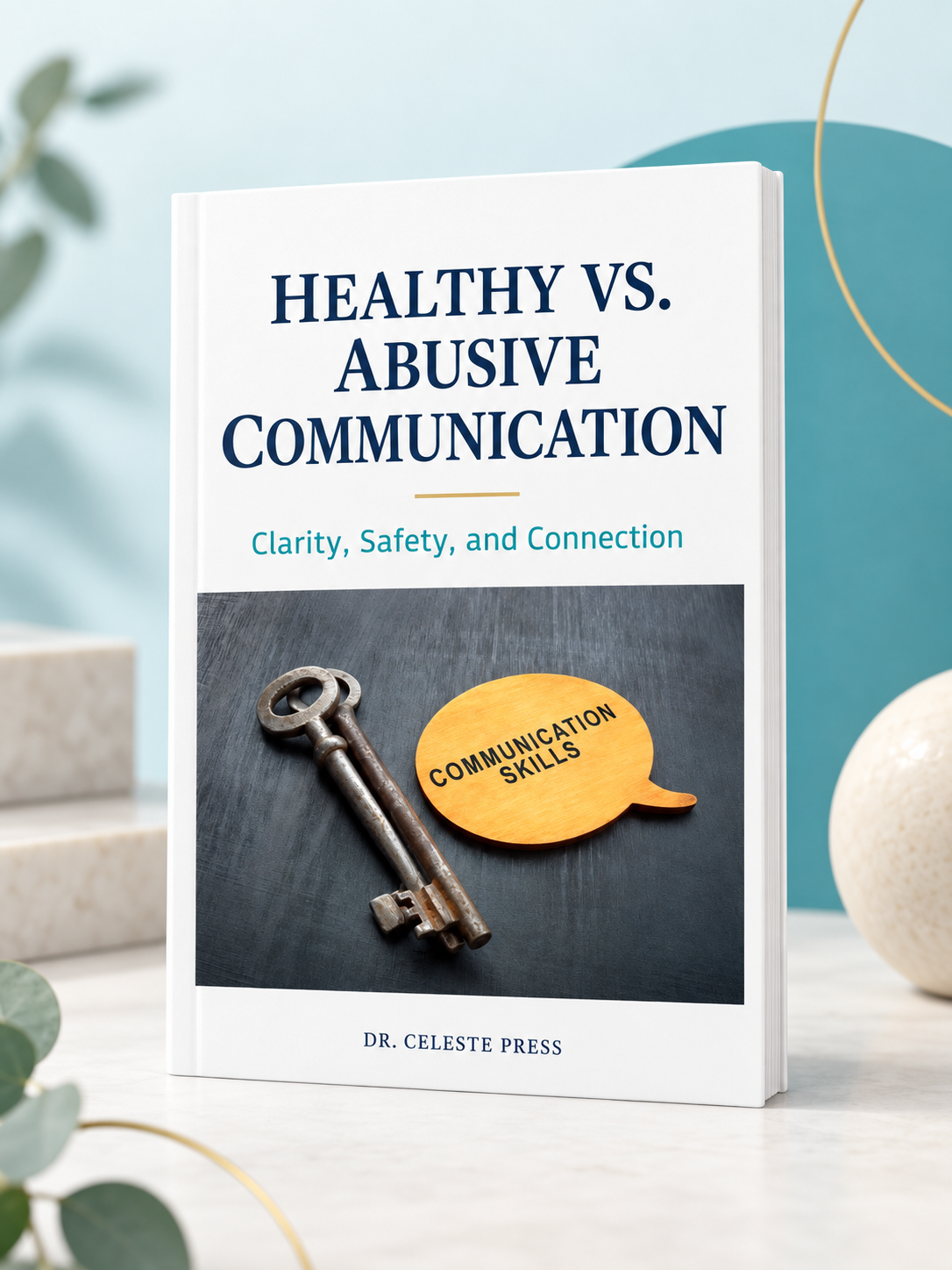
Closeness should not require the loss of safety, dignity, freedom, or self.
Healthy vs. Abusive Communication is a research-informed, attachment- and EFT-informed guide designed to help readers distinguish ordinary relationship conflict from unhealthy communication, emotional abuse, and coercive control.
All couples experience disagreements and may sometimes communicate poorly. What matters is the larger pattern: whether both people retain a voice, whether boundaries and differences are respected, whether responsibility leads to meaningful change, and whether each person remains free to make ordinary choices without fear or retaliation.
This guide examines communication within the broader relational context of power, safety, autonomy, accountability, connection, and freedom. It also explains why abuse is not simply a communication problem and why better communication skills alone cannot correct an ongoing pattern of coercion or control.
WHAT YOU’LL LEARN
• The differences among healthy conflict, unhealthy conflict, abusive communication, and coercive control
• What healthy communication sounds and looks like
• How healthy disagreement allows two realities to exist in the same conversation
• When unhealthy communication may still be repairable
• How emotional and psychological abuse can affect safety, identity, self-worth, and functioning
• How coercive control can restrict another person’s freedom and everyday life
• The differences between disagreement and gaslighting
• How digital monitoring and constant-access expectations can become controlling
• Why jealousy is a feeling—not permission to restrict another person’s autonomy
• How guilt, shame, passive aggression, punitive silence, threats, and intimidation can create compliance
• How emotional abuse can affect the body, nervous system, identity, and sense of reality
• What safety, respect, and secure connection create in a healthy relationship
• The elements of a meaningful apology and genuine repair
• The differences among requests, agreements, boundaries, rules, and controlling demands
• How autonomy and interdependence can coexist within a connected relationship
• The distinctions among secure dependence, interdependence, enmeshment, counterdependence, and dependence without agency
• Why “codependency” is a complicated and inconsistently defined term
• How differentiation helps people remain connected without abandoning themselves
• How attachment fears may explain—but never excuse—harmful behavior
• When an EFT negative-cycle framework may be appropriate and when it may erase responsibility
• Why some situations require specialized assessment before couples therapy
• How healthy relationships make room for both togetherness and individuality
PRACTICAL TOOLS INCLUDED
• A comparison of healthy conflict, unhealthy conflict, abusive communication, and coercive control
• Healthy-communication and healthy-relationship checklists
• Questions for evaluating freedom, safety, dignity, boundaries, and access to resources
• Examples of emotional abuse, gaslighting, digital coercion, isolation, guilt, shame, and intimidation
• Healthy communication and boundary scripts
• Examples comparing secure attachment reaches with controlling protests
• A complete repair and apology checklist
• Guidance for distinguishing boundaries from controlling rules
• Reflection prompts for autonomy, interdependence, differentiation, and relationship safety
• Guidance for recognizing when couples work may be unsafe
• Safety, advocacy, and support considerations
• Selected peer-reviewed research for continued learning
WHO THIS RESOURCE IS FOR
This guide may be helpful for:
• Individuals who want to better understand healthy and unhealthy communication
• People who are questioning whether behaviors in a current or former relationship may be emotionally abusive or controlling
• Individuals who feel confused, frightened, diminished, isolated, monitored, or unable to communicate freely
• Couples examining unhealthy patterns when both partners retain freedom, safety, and the ability to take responsibility
• People learning how boundaries, autonomy, interdependence, and secure connection work together
• Individuals who want practical language for making requests, setting boundaries, pausing conflict, and protecting dignity
• Therapists and helping professionals seeking a comprehensive educational resource for their own professional learning
This resource should not be used to pressure someone to disclose abuse, confront a controlling partner, remain in a relationship, leave a relationship, or participate in couples therapy. Decisions involving abuse, coercive control, separation, or immediate danger may require individualized safety planning and specialized professional support.
FORMAT AND DELIVERY
• One 34-page digital PDF booklet
• Standard US Letter size: 8.5 × 11 inches
• Designed for comfortable reading on a computer, tablet, or mobile device
• May be printed for the purchaser’s permitted individual use
• Delivered electronically as an instant digital download after purchase
This is a digital product. No physical product will be shipped.
EDUCATIONAL INFORMATION
This booklet is intended for educational and reflective purposes only. It cannot determine whether a specific relationship is abusive and is not a substitute for individualized mental-health, medical, legal, advocacy, crisis, or safety assessment.
Abuse can occur across genders, sexual orientations, ages, cultures, abilities, and socioeconomic groups. A person’s attachment history, trauma, fear, jealousy, emotional distress, or mental-health condition does not excuse threats, coercion, degradation, surveillance, sexual pressure, violence, or other abusive behavior.
If a partner may monitor devices or online activity, viewing, downloading, printing, or storing this booklet could increase risk. Consider using a safer device and contacting a domestic-violence advocate for individualized digital-safety and relationship-safety planning.
If you are experiencing coercion, stalking, threats, strangulation, forced sex, physical violence, reproductive coercion, digital monitoring, financial control, confinement, or immediate danger, consider contacting an appropriate emergency service, domestic-violence resource, legal professional, medical professional, or qualified clinician when it is safe to do so.
LICENSE AND PERMITTED USE
Your purchase includes an individual-use license.
You may:
• Download and save the PDF for your own use
• View the booklet on your personal devices
• Print copies for your own personal use
• Review and complete the resource with your partner when appropriate and safe
You may not:
• Share the digital file with friends, colleagues, clients, supervisees, groups, or organizations
• Email, upload, copy, or distribute the PDF to others
• Place the resource in a shared drive, shared library, membership platform, course, or resource collection
• Print or distribute copies as multi-client handouts
• Reproduce, modify, republish, translate, rebrand, sell, or resell any portion of the resource
• Remove the Dr. Celeste Press name, copyright notice, or other identifying information
Each individual or professional who wants a copy must purchase their own licensed copy unless separate written permission or an organizational license has been obtained from Dr. Celeste Press.
DIGITAL-PRODUCT POLICY
Because this digital product is delivered electronically, all sales are final. If you experience a technical problem accessing your purchase, please contact us for assistance.
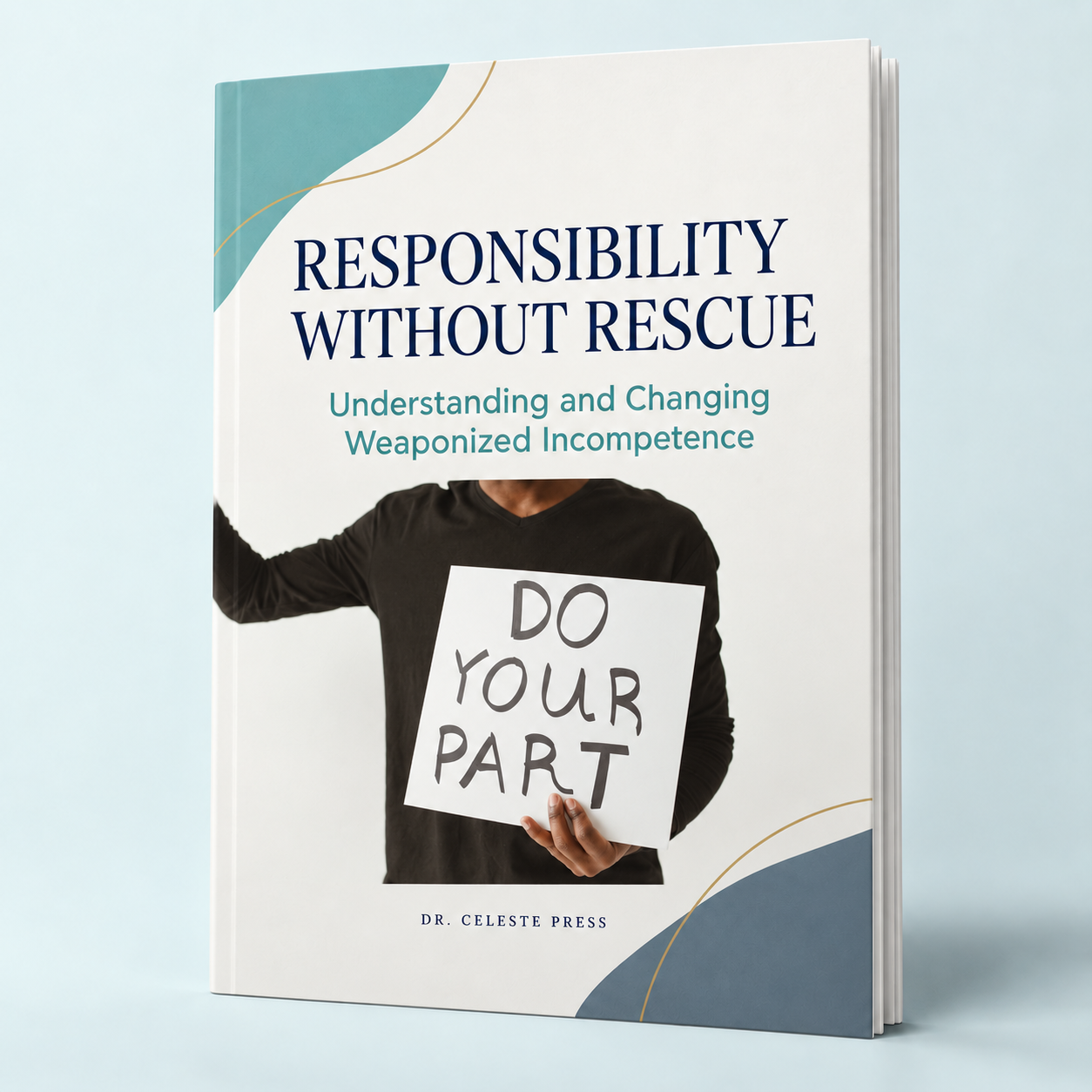
Understand how repeated helplessness, poor effort, avoidance, or incomplete follow-through can quietly transfer both responsibility and mental load to a partner.
Responsibility Without Rescue is a research-informed relationship guide to recognizing and changing patterns commonly described as weaponized incompetence.
The central question is straightforward: when a shared responsibility becomes difficult or unwanted, does the person who owns it learn, adapt, and follow through—or does the work migrate to their partner?
Using an attachment and Emotionally Focused Therapy lens, this guide helps couples distinguish genuine limitations or skill gaps from repeated responsibility-shifting. It also provides practical tools for creating clear ownership, supporting learning without taking over, and rebuilding fairness and dependability.
WHO THIS RESOURCE IS FOR
This guide may be especially helpful for:
• Couples struggling with unequal household or family responsibilities
• Partners carrying both visible tasks and invisible mental load
• People who feel more like a manager or parent than a partner
• Individuals wondering whether they may be underfunctioning or overfunctioning
• Couples affected by repeated forgetting, unfinished tasks, or failed agreements
• Partners navigating real differences in ability, capacity, experience, or executive functioning
• Couples working to restore fairness, trust, teamwork, and follow-through
• Therapists seeking a relationship-education recommendation for clients
WHAT IS WEAPONIZED INCOMPETENCE?
Weaponized incompetence is a popular, nonclinical term for a repeated pattern in which apparent inability, poor effort, avoidance, or helplessness shifts a responsibility—and the thinking required to manage it—onto someone else.
The behavior may or may not be consciously planned. This guide focuses on the repeated function, impact, accountability, capacity, and evidence of change rather than attempting to diagnose hidden motives.
WHAT YOU’LL LEARN
• How responsibility-shifting patterns develop
• The difference between a genuine skill gap and repeated avoidance
• Why one mistake or a different method does not establish weaponized incompetence
• How ADHD, disability, depression, trauma, pain, fatigue, cognitive changes, or cultural learning may affect performance
• Why accommodation should support equitable ownership rather than automatic exemption
• How to recognize the pattern in yourself without relying on shame
• How to observe repeated behavior in a partner without claiming to know intent
• Why invisible cognitive labor matters as much as the final visible task
• How unequal ownership can affect trust, desire, respect, rest, and connection
• How overfunctioning and underfunctioning reinforce each other
• How to support learning without becoming the manager
• How to create clearer agreements and evaluate follow-through over time
OWNERSHIP FROM BEGINNING TO END
The guide explains that ownership includes more than completing the final step. Genuine ownership may involve:
• Noticing or anticipating the need
• Planning what must happen
• Gathering information and resources
• Completing the task
• Communicating with affected people
• Monitoring progress and deadlines
• Correcting problems and repairing mistakes
PRACTICAL TOOLS
The booklet includes:
• A genuine-skill-gap versus responsibility-shifting comparison
• A personal self-check for underfunctioning patterns
• Indicators for observing repeated behavior in a partner
• An explanation of visible and invisible cognitive labor
• An attachment-based overfunctioning and underfunctioning cycle
• A five-step process for addressing the pattern directly
• Strategies for supporting without taking over
• Replacement language for common helpless or defensive responses
• A responsible apology script
• A boundary script for the overfunctioning partner
• A Two-Week Responsibility Reset worksheet
• Selected peer-reviewed research
FAIRNESS AND CAPACITY
Fairness does not always mean dividing every task equally. Capacity can change because of illness, disability, pregnancy, work demands, grief, caregiving, pain, or other circumstances.
A fair arrangement is explicit, collaborative, responsive, and open to revision. Real limitations may change how a task is completed or how labor is divided. Healthy adaptation still includes honesty, reliable systems, communication, and ownership of an equitable share.
IMPORTANT SAFETY INFORMATION
Do not allow children, pets, health, housing, finances, or physical safety to be harmed in order to create a natural consequence or teach someone a lesson.
If requests for equitable participation lead to intimidation, financial control, threats, stalking, sexual pressure, retaliation, or violence, the problem is more than an unequal-chore pattern. Seek confidential individual and safety support. Joint therapy may not be appropriate until safety has been assessed.
FORMAT AND DELIVERY
This is a digital product. No physical product will be shipped.
File format: PDF
Length: 14 pages
Page size: US Letter
Designed for: Digital reading or printing
After completing your purchase, follow the provided download instructions and save a copy to your device.
EDUCATIONAL INFORMATION
Weaponized incompetence is a popular descriptive term, not a clinical diagnosis. Direct peer-reviewed research using that exact phrase remains limited. This guide draws from research on household labor, cognitive labor, perceived fairness, attachment, responsiveness, and couple well-being.
This resource provides general relationship education and is not a substitute for individualized psychotherapy, medical care, disability assessment, legal guidance, safety planning, or emergency services.
LICENSE AND PERMITTED USE
Your purchase includes a license for individual or relationship use. You may save a copy, print the guide for yourself, and share it with your partner for use within your relationship.
Please do not share the complete file with friends, colleagues, clients, groups, or your broader community. Instead, share the original Hub Library product link so others can obtain their own licensed copy.
The guide may not be resold, redistributed, republished, uploaded to a shared resource library, altered and presented as another person’s work, or used as a handout for multiple clients without written permission.
DIGITAL-PRODUCT POLICY
Because this digital product is delivered electronically, all sales are final. If you experience a technical problem accessing your purchase, please contact us for assistance.
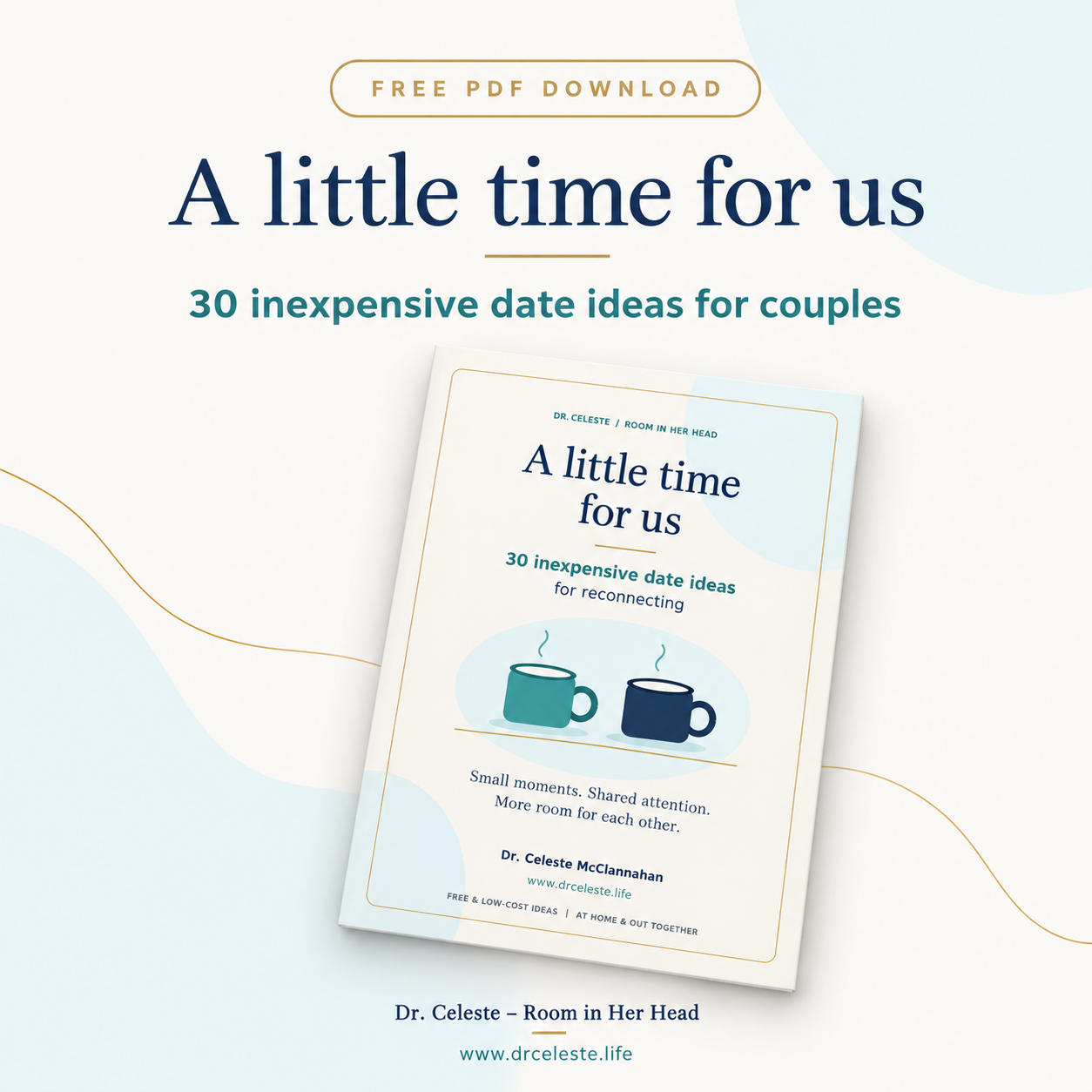
Between work, household responsibilities, parenting, and everyday stress, time together can start to feel like one more thing to schedule. Reconnecting does not have to mean an expensive dinner or an elaborate evening.
A Little Time for Us offers 30 approachable date ideas for different budgets, energy levels, and seasons of life. Whether you have ten minutes at home or an afternoon to get out together, this free resource gives you a place to start.
Each idea includes an estimated time, estimated cost, and a conversation prompt to invite curiosity and connection. You will also find guidance for sharing the planning so creating meaningful time together becomes a shared responsibility.
What’s included
30 free and low-cost date ideas.
Quick moments of connection for busy days.
Cozy dates at home.
Simple outings and playful activities.
A connection prompt for every date.
A five-page PDF you can save or print.
Choose one idea that feels manageable. Give each other your attention, stay curious, and let small moments count.
Clinical expertise with warmth and practical guidance
Dr. Celeste McClannahan, PhD, LMFT, CST, CFRC, is a relationship expert, Certified Sex Therapist, Certified First Responder Counselor, supervisor, author, and educator who creates practical resources for healthier relationships and stronger clinical practice.
Meet Dr. Celeste