

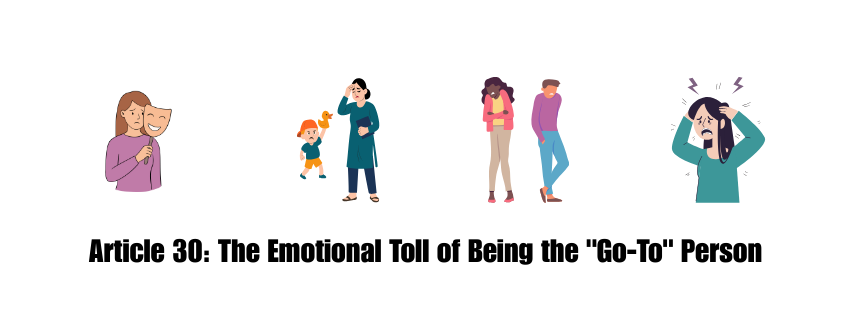
Article 30: The Emotional Toll of Being the "Go-To" Person
Every household has someone who’s the default. The go-to person. The one everyone turns to when something needs doing, when something breaks, when emotions run high, or when someone forgets. For many women, that role becomes more than a responsibility — it becomes an identity. And over time, it takes a toll.
Introduction Every household has someone who’s the default. The go-to person. The one everyone turns to when something needs doing, when something breaks, when emotions run high, or when someone forgets. For many women, that role becomes more than a responsibility — it becomes an identity. And over time, it takes a toll.
What It Means to Be the Go-To Person The go-to person isn’t just organized. She’s dependable. She holds the mental map of everyone’s needs. She knows who’s overwhelmed, what’s due tomorrow, when the car needs an oil change, and who’s feeling off.
She is the:
Scheduler
Counselor
Problem solver
Emotional regulator
Logistics coordinator
She becomes the center of everyone else’s functioning — but may feel like she’s disappearing in the process.
The Weight of Being the Anchor Being the go-to person can feel like:
Constantly monitoring everyone else’s emotional states
Being interrupted even during personal time because "you’ll know what to do"
Having no backup, even when you're exhausted
Feeling like things fall apart if you step away
It’s a role built on reliability — but often, it’s supported by personal depletion.
Real-Life Illustration Julie is the first person her kids come to with questions, complaints, and worries. Greg asks her where things are, what they’re doing this weekend, and who’s picking up the dry cleaning. Her parents call her when they need help with bills or appointments.
She’s proud of being capable — but sometimes she wonders, “Who do I go to?”
The Emotional Toll Being the go-to person can lead to:
Chronic fatigue
Emotional numbing
Heightened irritability
Loss of identity outside of service roles
A deep longing for someone else to notice and act without being asked
It creates a pressure cooker of quiet distress: no one seems to realize the weight — and it keeps piling up.
Why It’s So Hard to Step Back Stepping out of the go-to role is hard, especially when it’s tied to self-worth. Many women have internalized the belief that being needed equals being valuable. Letting go of that can feel like abandonment — not just of others, but of your own identity.
There’s also fear: “If I stop, who will step in?” And the answer isn’t always obvious — especially if others have become used to not needing to.
Changing the Narrative It’s possible to stay reliable without becoming invisible. That starts with:
Naming the role and its impact
Asking for shared responsibility
Teaching others how to step in, then letting them do it their way
Creating boundaries that protect your energy and peace
Partners and family members can support this shift by:
Noticing and acting without prompts
Asking what they can take over long-term, not just temporarily
Validating the go-to person’s fatigue and honoring their need for rest
Reflection Prompt Do you feel like the go-to person in your home or extended family? What would it look like to share that role more equally?
Conclusion Being the go-to person can feel empowering — until it starts to feel like a trap. When everyone leans on one person, that person gets worn down. But it doesn’t have to stay that way. When responsibility is shared and visibility is restored, the go-to person can finally exhale — and reclaim the parts of herself that have been waiting for space.

Article 28: How Mental Load Affects Intimacy
Motherhood is often described as a beautiful transformation — but what’s less discussed is how much it can also feel like an unraveling. When a woman becomes a mother, she doesn’t simply add a role to her life — she often watches other parts of her identity shift, shrink, or even disappear. While becoming a mother can deepen love and purpose, it can also complicate the relationship a woman has with herself, especially when mental load and societal expectations begin to define her worth.
Introduction At first glance, intimacy might seem unrelated to mental load. But the truth is, intimacy — both emotional and physical — thrives on connection, safety, and reciprocity. When one partner is overwhelmed by invisible labor and the other remains unaware, the emotional gap that forms doesn’t just affect day-to-day functioning — it shows up in the bedroom and in the depth of the relationship.
The Connection Between Mental Load and Intimacy Intimacy requires presence, vulnerability, and mutual care. But when one partner is mentally burdened by constant planning, tracking, and managing — especially when that labor is unacknowledged — it becomes hard to feel safe enough to let go, connect, and engage.
When you’re:
Always keeping track of everyone’s needs
Resentful over unequal effort
Feeling emotionally unsupported
Managing your partner instead of relating to them
…it becomes nearly impossible to access desire, affection, or emotional openness.
Real-Life Illustration Julie notices that she doesn’t feel connected to Greg anymore. It’s not that she doesn’t love him — it’s that she feels emotionally alone. She carries the weight of the household and their family’s well-being, and when she brings it up, Greg responds defensively or dismissively.
When Greg initiates intimacy, Julie often turns away — not because she’s rejecting him, but because she feels unseen. She can’t access closeness when she’s swimming in mental exhaustion and emotional invisibility.
Why It’s So Easy to Miss Mental and emotional labor are often silent. Partners may assume everything is fine because nothing’s been said — but silence isn’t satisfaction. It’s often survival.
When intimacy wanes, the cause is often misdiagnosed:
“We’re just busy.”
“Parenting is stressful.”
“We’re in a rut.”
But beneath the surface may be an emotional disconnect driven by inequality — not a lack of love.
What Intimacy Needs to Thrive For intimacy to flourish, both partners need to:
Feel emotionally safe and supported
Experience equality in responsibility
Trust that the other person sees and values their effort
Have space to relax and be present, not perform
When one partner is overburdened and the other disengaged, the unburdened partner still wants connection — while the burdened partner wants relief. This mismatch creates emotional distance that is mistaken for disinterest.
Restoring Connection Through Shared Load Rebuilding intimacy starts with recognizing that love lives in the details. Taking on mental load is an act of love — and an invitation to closeness. Simple shifts make a big difference:
Taking initiative without waiting to be asked
Acknowledging invisible work verbally
Being emotionally present — not just physically nearby
Asking your partner what would help them feel truly off-duty
These actions signal care and create the emotional conditions that make vulnerability possible.
Reflection Prompt When was the last time you felt truly connected to your partner — emotionally and physically? What role did shared responsibility play in that feeling?
Conclusion Intimacy doesn’t thrive in imbalance. It requires mutual effort, emotional attunement, and the space to be vulnerable. When the mental load is shared — not just acknowledged, but owned — emotional and physical closeness become possible again. Because in the end, love is not just a feeling — it’s a practice of showing up, equally and consistently.

Article 9: Gendered Assumptions About Task Ownership
Introduction In many households, who does what isn’t just based on skills or availability — it’s rooted in deeply ingrained beliefs about gender. These beliefs, often unspoken, shape who is expected to notice what needs to be done, who takes charge without being asked, and who feels responsible when things slip through the cracks. Understanding these assumptions is essential to dismantling the mental load imbalance.
Introduction In many households, who does what isn’t just based on skills or availability — it’s rooted in deeply ingrained beliefs about gender. These beliefs, often unspoken, shape who is expected to notice what needs to be done, who takes charge without being asked, and who feels responsible when things slip through the cracks. Understanding these assumptions is essential to dismantling the mental load imbalance.
The Default Parent and Manager Women are often expected to take the lead in home and family responsibilities, not because they want to, but because it’s assumed they’re better at it. These expectations can start early in life — girls are often praised for being helpful, tidy, and nurturing, while boys are praised for independence and achievement. By adulthood, these roles have become second nature.
In many heterosexual relationships, this leads to the woman being the “default parent” and household manager. She becomes the one who tracks doctor appointments, monitors emotional needs, coordinates social calendars, and remembers every detail of family life. Meanwhile, the man may view himself as a helper — stepping in when asked, but not seeing these tasks as his core responsibility.
Invisible Scripts in Action These assumptions show up in subtle but powerful ways:
When a child gets sick, it’s assumed she’ll handle it.
When something in the house needs restocking, it’s assumed she’ll notice.
When a holiday or event comes up, it’s assumed she’ll plan for it.
Even when tasks are shared, the underlying assumption often remains: that she is the one responsible unless she delegates or directs.
The Mental Load of Ownership Task ownership isn’t just about doing a job. It’s about carrying the mental weight of remembering, planning, and following through. When men only participate as assistants — waiting to be told what to do — they may be unaware of the deeper burden their partner is carrying.
If she forgets something, the consequences are felt. If he forgets, it’s often seen as a simple mistake. This unequal accountability reinforces the idea that the home is ultimately her domain — a belief that makes it hard to truly share the load.
Real-Life Illustration Julie didn’t choose to be the household manager — it just happened. When their first child was born, she took the lead on feeding schedules, doctor visits, and baby supplies. Greg was helpful and loving, but he followed her lead. Over time, Julie became the expert. Greg defaulted to her knowledge. Now, years later, Julie is exhausted, not just from the tasks but from the constant mental weight of being “in charge” by default.
Greg isn’t trying to avoid responsibility. He simply didn’t realize there was a script — and that he was playing a passive role in it.
Breaking the Script Undoing gendered assumptions takes intention and awareness. It means:
Questioning who usually notices and initiates tasks
Sharing the invisible work, not just the visible chores
Accepting accountability for outcomes, not waiting for direction
Reframing responsibility as shared ownership, not occasional help
It also means talking openly about roles and expectations — something many couples avoid until resentment builds.
Reflection Prompt Take a look at your day. What tasks did you take full responsibility for — including noticing, planning, and executing? Are there patterns in your home about who assumes ownership and who follows? What would it take to change those patterns?
Conclusion Gendered assumptions about task ownership are so deeply embedded that they often go unnoticed. But by examining them, questioning them, and consciously shifting the balance, couples can create relationships where both partners are true equals — not just in doing, but in owning the shared life they’re building.

Article 7: Delegating Responsibilities and the Emotional Toll
Introduction Delegating tasks might seem like a straightforward solution to lighten the mental load — but it’s not that simple. For many women, delegating comes with its own burden. It’s not just about handing off a chore; it’s about thinking through what needs to be done, explaining it, monitoring the results, and dealing with the emotional fallout if it doesn’t get done correctly or on time. Delegation, when not approached with care and understanding, can actually add to the load rather than relieve it.
Introduction Delegating tasks might seem like a straightforward solution to lighten the mental load — but it’s not that simple. For many women, delegating comes with its own burden. It’s not just about handing off a chore; it’s about thinking through what needs to be done, explaining it, monitoring the results, and dealing with the emotional fallout if it doesn’t get done correctly or on time. Delegation, when not approached with care and understanding, can actually add to the load rather than relieve it.
Delegating Is Still Managing When someone asks, “Why didn’t you just ask for help?” it implies that the responsibility still belongs to her — and that asking is a requirement. But when she has to make the mental effort to assign a task, outline the steps, and follow up on the outcome, she hasn’t really been relieved of the responsibility. She’s just extended it into a project-management role.
Delegating also often involves emotional risk. What happens if the task isn’t completed correctly? What if it’s forgotten altogether? The consequences typically fall back on her, especially in households where she’s expected to be the “default parent” or household manager. As a result, many women find it easier to just do the task themselves rather than deal with the mental and emotional effort of delegating it.
The Emotional Toll of Being the Household Manager Being the one who always has to assign tasks reinforces the idea that she’s ultimately in charge of everything. Over time, this imbalance can lead to:
Resentment toward a partner who “helps” rather than shares ownership
Fatigue from always having to think ahead, plan, and track others’ contributions
Feeling unsupported or unseen, even when help is technically offered
A deep sense of loneliness from carrying the invisible responsibility
This emotional weight builds up. It’s not about the task itself — it’s about the responsibility for the task. True relief only happens when the responsibility is shared, not when one partner waits to be directed.
Real-Life Illustration Let’s look at Julie again. She asks Greg to make the kids’ lunches for the next day. Greg says, “Sure!” But instead of taking full ownership, he waits until she reminds him. Then, unsure of what to pack, he asks her what the kids like. After he finishes, he asks her to double-check in the morning. The next morning, she finds out he forgot the ice pack and packed peanuts for the kid whose school is nut-free. So now she’s redoing the lunch, managing the consequences, and feeling frustrated that delegating became more work.
From Greg’s perspective, he did what was asked. But from Julie’s point of view, she had to plan, manage, and fix — which meant she never really got to let go of the responsibility at all.
True Delegation Means Ownership For delegation to be truly helpful, the task has to be owned from start to finish. That means:
Not waiting to be asked
Taking initiative to notice what needs to be done
Managing the details without guidance
Learning preferences, routines, and responsibilities
It also means being willing to take feedback and correct mistakes without defensiveness. Sharing household responsibilities means learning to be equally competent in the details — just like she has.
Reflection Prompt Think of the last time your partner asked for help. Did you take full ownership of the task, or did you rely on her guidance and oversight? What would it look like to own that task entirely, without needing reminders or instructions?
Conclusion Delegating is not a shortcut to equality — it can be a trap that reinforces imbalance. True partnership requires shared ownership of the mental and emotional work behind tasks. By taking initiative and carrying tasks from start to finish, you not only reduce her mental load — you prove that the household belongs to both of you, not just to her.