

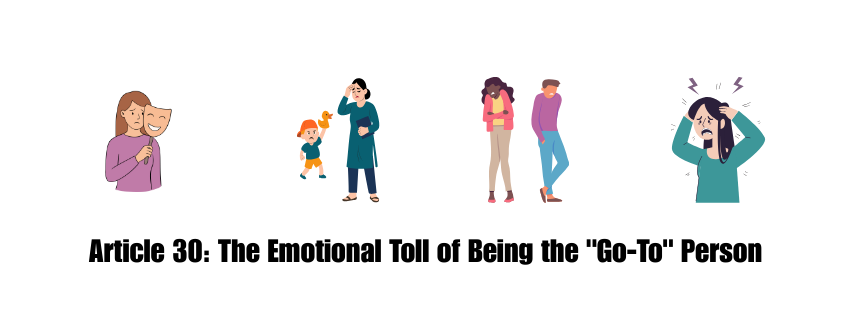
Article 30: The Emotional Toll of Being the "Go-To" Person
Every household has someone who’s the default. The go-to person. The one everyone turns to when something needs doing, when something breaks, when emotions run high, or when someone forgets. For many women, that role becomes more than a responsibility — it becomes an identity. And over time, it takes a toll.
Introduction Every household has someone who’s the default. The go-to person. The one everyone turns to when something needs doing, when something breaks, when emotions run high, or when someone forgets. For many women, that role becomes more than a responsibility — it becomes an identity. And over time, it takes a toll.
What It Means to Be the Go-To Person The go-to person isn’t just organized. She’s dependable. She holds the mental map of everyone’s needs. She knows who’s overwhelmed, what’s due tomorrow, when the car needs an oil change, and who’s feeling off.
She is the:
Scheduler
Counselor
Problem solver
Emotional regulator
Logistics coordinator
She becomes the center of everyone else’s functioning — but may feel like she’s disappearing in the process.
The Weight of Being the Anchor Being the go-to person can feel like:
Constantly monitoring everyone else’s emotional states
Being interrupted even during personal time because "you’ll know what to do"
Having no backup, even when you're exhausted
Feeling like things fall apart if you step away
It’s a role built on reliability — but often, it’s supported by personal depletion.
Real-Life Illustration Julie is the first person her kids come to with questions, complaints, and worries. Greg asks her where things are, what they’re doing this weekend, and who’s picking up the dry cleaning. Her parents call her when they need help with bills or appointments.
She’s proud of being capable — but sometimes she wonders, “Who do I go to?”
The Emotional Toll Being the go-to person can lead to:
Chronic fatigue
Emotional numbing
Heightened irritability
Loss of identity outside of service roles
A deep longing for someone else to notice and act without being asked
It creates a pressure cooker of quiet distress: no one seems to realize the weight — and it keeps piling up.
Why It’s So Hard to Step Back Stepping out of the go-to role is hard, especially when it’s tied to self-worth. Many women have internalized the belief that being needed equals being valuable. Letting go of that can feel like abandonment — not just of others, but of your own identity.
There’s also fear: “If I stop, who will step in?” And the answer isn’t always obvious — especially if others have become used to not needing to.
Changing the Narrative It’s possible to stay reliable without becoming invisible. That starts with:
Naming the role and its impact
Asking for shared responsibility
Teaching others how to step in, then letting them do it their way
Creating boundaries that protect your energy and peace
Partners and family members can support this shift by:
Noticing and acting without prompts
Asking what they can take over long-term, not just temporarily
Validating the go-to person’s fatigue and honoring their need for rest
Reflection Prompt Do you feel like the go-to person in your home or extended family? What would it look like to share that role more equally?
Conclusion Being the go-to person can feel empowering — until it starts to feel like a trap. When everyone leans on one person, that person gets worn down. But it doesn’t have to stay that way. When responsibility is shared and visibility is restored, the go-to person can finally exhale — and reclaim the parts of herself that have been waiting for space.