Celeste McClannahan Celeste McClannahan

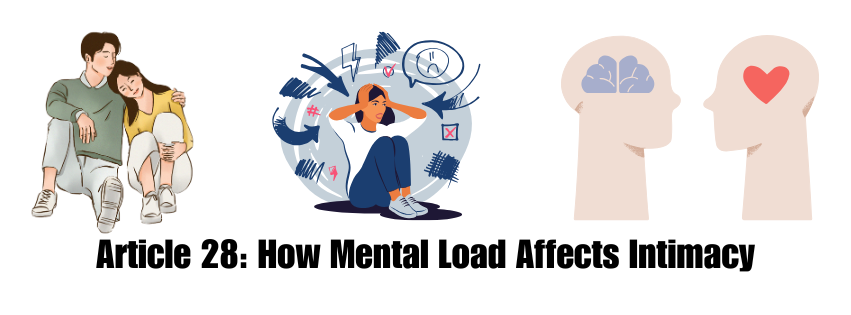
Article 28: How Mental Load Affects Intimacy

Motherhood is often described as a beautiful transformation — but what’s less discussed is how much it can also feel like an unraveling. When a woman becomes a mother, she doesn’t simply add a role to her life — she often watches other parts of her identity shift, shrink, or even disappear. While becoming a mother can deepen love and purpose, it can also complicate the relationship a woman has with herself, especially when mental load and societal expectations begin to define her worth.

Introduction At first glance, intimacy might seem unrelated to mental load. But the truth is, intimacy — both emotional and physical — thrives on connection, safety, and reciprocity. When one partner is overwhelmed by invisible labor and the other remains unaware, the emotional gap that forms doesn’t just affect day-to-day functioning — it shows up in the bedroom and in the depth of the relationship.

The Connection Between Mental Load and Intimacy Intimacy requires presence, vulnerability, and mutual care. But when one partner is mentally burdened by constant planning, tracking, and managing — especially when that labor is unacknowledged — it becomes hard to feel safe enough to let go, connect, and engage.

When you’re:

  • Always keeping track of everyone’s needs

  • Resentful over unequal effort

  • Feeling emotionally unsupported

  • Managing your partner instead of relating to them

…it becomes nearly impossible to access desire, affection, or emotional openness.

Real-Life Illustration Julie notices that she doesn’t feel connected to Greg anymore. It’s not that she doesn’t love him — it’s that she feels emotionally alone. She carries the weight of the household and their family’s well-being, and when she brings it up, Greg responds defensively or dismissively.

When Greg initiates intimacy, Julie often turns away — not because she’s rejecting him, but because she feels unseen. She can’t access closeness when she’s swimming in mental exhaustion and emotional invisibility.

Why It’s So Easy to Miss Mental and emotional labor are often silent. Partners may assume everything is fine because nothing’s been said — but silence isn’t satisfaction. It’s often survival.

When intimacy wanes, the cause is often misdiagnosed:

  • “We’re just busy.”

  • “Parenting is stressful.”

  • “We’re in a rut.”

But beneath the surface may be an emotional disconnect driven by inequality — not a lack of love.

What Intimacy Needs to Thrive For intimacy to flourish, both partners need to:

  • Feel emotionally safe and supported

  • Experience equality in responsibility

  • Trust that the other person sees and values their effort

  • Have space to relax and be present, not perform

When one partner is overburdened and the other disengaged, the unburdened partner still wants connection — while the burdened partner wants relief. This mismatch creates emotional distance that is mistaken for disinterest.

Restoring Connection Through Shared Load Rebuilding intimacy starts with recognizing that love lives in the details. Taking on mental load is an act of love — and an invitation to closeness. Simple shifts make a big difference:

  • Taking initiative without waiting to be asked

  • Acknowledging invisible work verbally

  • Being emotionally present — not just physically nearby

  • Asking your partner what would help them feel truly off-duty

These actions signal care and create the emotional conditions that make vulnerability possible.

Reflection Prompt When was the last time you felt truly connected to your partner — emotionally and physically? What role did shared responsibility play in that feeling?

Conclusion Intimacy doesn’t thrive in imbalance. It requires mutual effort, emotional attunement, and the space to be vulnerable. When the mental load is shared — not just acknowledged, but owned — emotional and physical closeness become possible again. Because in the end, love is not just a feeling — it’s a practice of showing up, equally and consistently.

Read More