


Article 29: Feeling Alone While Surrounded by People
There’s a particular kind of loneliness that doesn’t come from being physically alone — it comes from carrying too much, unnoticed, in the presence of others. This form of emotional isolation is common among those who hold the mental and emotional weight of their households. They’re surrounded by people they love, yet feel invisible in the very systems they maintain.
Introduction There’s a particular kind of loneliness that doesn’t come from being physically alone — it comes from carrying too much, unnoticed, in the presence of others. This form of emotional isolation is common among those who hold the mental and emotional weight of their households. They’re surrounded by people they love, yet feel invisible in the very systems they maintain.
The Loneliness of Being the One Who Remembers When one partner becomes the central processor for all things household, parenting, logistics, and emotional care, they often feel like they exist in a different reality from their partner. They’re holding the to-do list, the social dynamics, the logistics, and the emotional pulse of the home — often in silence.
What they long for isn’t company. It’s recognition.
Signs of Hidden Loneliness
Going through the motions of family life while feeling emotionally detached
Offering support to others without receiving it in return
Feeling emotionally invisible, even while engaging with loved ones
Carrying burdens silently to “keep the peace”
This kind of loneliness can deepen when your partner is nearby but disconnected from your inner world — your thoughts, stress, and emotional fatigue.
Real-Life Illustration Julie sits at dinner with her family. Everyone is talking, laughing, eating. But inside, she feels numb. She’s still thinking about the unread emails from school, the mental list of groceries to buy, the appointment she needs to reschedule. No one else sees it — they assume she’s fine. Greg thanks her for dinner, but doesn’t ask how she is.
She smiles. But what she really wants is for someone to say, “You seem tired — what can I take off your plate?”
Why It’s So Hard to Talk About This kind of loneliness often doesn’t get voiced because:
It’s hard to explain something invisible
It feels like complaining about things that “should be fine”
It’s vulnerable to admit that you feel alone when you’re not physically isolated
But emotional invisibility is real — and when left unspoken, it can grow into resentment and disconnection.
Bridging the Emotional Distance Connection requires more than proximity. To bridge the gap, both partners must:
Ask about the emotional labor behind the day
Express gratitude for the invisible work
Be present — not just physically, but emotionally
Create moments for genuine check-ins, not just functional conversations
For the Partner Who Feels Alone
Write down what you’re carrying and share it
Ask for more than task-sharing — ask for emotional noticing
Create space for your own emotional needs to be named and met
Reflection Prompt Have you ever felt emotionally invisible, even when surrounded by people? What kind of support would help you feel seen?
Conclusion Loneliness doesn’t always mean being alone — sometimes it means being everything for everyone else and nothing for yourself. When emotional labor and invisible work go unrecognized, the person doing them can feel deeply isolated. But that can change. With openness, noticing, and shared presence, connection can be restored — and loneliness can begin to dissolve.
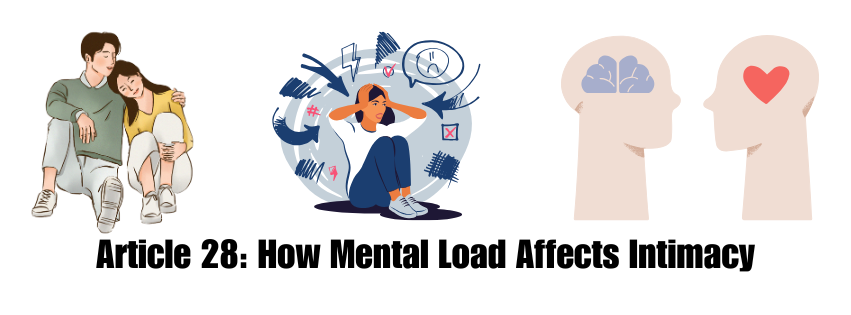
Article 28: How Mental Load Affects Intimacy
Motherhood is often described as a beautiful transformation — but what’s less discussed is how much it can also feel like an unraveling. When a woman becomes a mother, she doesn’t simply add a role to her life — she often watches other parts of her identity shift, shrink, or even disappear. While becoming a mother can deepen love and purpose, it can also complicate the relationship a woman has with herself, especially when mental load and societal expectations begin to define her worth.
Introduction At first glance, intimacy might seem unrelated to mental load. But the truth is, intimacy — both emotional and physical — thrives on connection, safety, and reciprocity. When one partner is overwhelmed by invisible labor and the other remains unaware, the emotional gap that forms doesn’t just affect day-to-day functioning — it shows up in the bedroom and in the depth of the relationship.
The Connection Between Mental Load and Intimacy Intimacy requires presence, vulnerability, and mutual care. But when one partner is mentally burdened by constant planning, tracking, and managing — especially when that labor is unacknowledged — it becomes hard to feel safe enough to let go, connect, and engage.
When you’re:
Always keeping track of everyone’s needs
Resentful over unequal effort
Feeling emotionally unsupported
Managing your partner instead of relating to them
…it becomes nearly impossible to access desire, affection, or emotional openness.
Real-Life Illustration Julie notices that she doesn’t feel connected to Greg anymore. It’s not that she doesn’t love him — it’s that she feels emotionally alone. She carries the weight of the household and their family’s well-being, and when she brings it up, Greg responds defensively or dismissively.
When Greg initiates intimacy, Julie often turns away — not because she’s rejecting him, but because she feels unseen. She can’t access closeness when she’s swimming in mental exhaustion and emotional invisibility.
Why It’s So Easy to Miss Mental and emotional labor are often silent. Partners may assume everything is fine because nothing’s been said — but silence isn’t satisfaction. It’s often survival.
When intimacy wanes, the cause is often misdiagnosed:
“We’re just busy.”
“Parenting is stressful.”
“We’re in a rut.”
But beneath the surface may be an emotional disconnect driven by inequality — not a lack of love.
What Intimacy Needs to Thrive For intimacy to flourish, both partners need to:
Feel emotionally safe and supported
Experience equality in responsibility
Trust that the other person sees and values their effort
Have space to relax and be present, not perform
When one partner is overburdened and the other disengaged, the unburdened partner still wants connection — while the burdened partner wants relief. This mismatch creates emotional distance that is mistaken for disinterest.
Restoring Connection Through Shared Load Rebuilding intimacy starts with recognizing that love lives in the details. Taking on mental load is an act of love — and an invitation to closeness. Simple shifts make a big difference:
Taking initiative without waiting to be asked
Acknowledging invisible work verbally
Being emotionally present — not just physically nearby
Asking your partner what would help them feel truly off-duty
These actions signal care and create the emotional conditions that make vulnerability possible.
Reflection Prompt When was the last time you felt truly connected to your partner — emotionally and physically? What role did shared responsibility play in that feeling?
Conclusion Intimacy doesn’t thrive in imbalance. It requires mutual effort, emotional attunement, and the space to be vulnerable. When the mental load is shared — not just acknowledged, but owned — emotional and physical closeness become possible again. Because in the end, love is not just a feeling — it’s a practice of showing up, equally and consistently.

Article 10: Societal Norms Reinforcing Unequal Load Distribution
Introduction Mental load doesn’t develop in a vacuum — it’s shaped by the society we live in. From media messages to cultural traditions, the world around us constantly reinforces the idea that women should be the primary caretakers and organizers of home life. These societal norms are powerful forces, silently dictating expectations and shaping behavior.
Introduction Mental load doesn’t develop in a vacuum — it’s shaped by the society we live in. From media messages to cultural traditions, the world around us constantly reinforces the idea that women should be the primary caretakers and organizers of home life. These societal norms are powerful forces, silently dictating expectations and shaping behavior.
The Cultural Message to Women From a young age, women receive the message that they are expected to nurture, organize, and remember for others. Whether it’s through fairy tales that celebrate self-sacrifice, advertising that targets women as the “household CEO,” or the lack of role models showing men as active caregivers, the message is clear: the domestic domain is a woman’s responsibility.
This conditioning shows up in everyday ways. Women are often the ones who are expected to remember birthdays, plan holidays, keep family in touch, and maintain social traditions. These roles are romanticized — she’s the one who “holds the family together” — but they are also relentless and unrecognized forms of labor.
How Society Lets Men Off the Hook Conversely, men are rarely taught that they are equally responsible for domestic life. When men do contribute — by taking the kids out or cooking dinner — they are often praised for doing “above and beyond,” even if the same acts are expected daily of their female partners. This uneven praise creates a standard where male participation is optional and female participation is assumed.
This isn’t just about chores. It’s about who is expected to carry the emotional and cognitive responsibility of making the household run. Society often sees women as naturally better at multitasking, organizing, or nurturing — as if they are biologically programmed for the mental load. These ideas are not based in fact, but they persist because they are comfortable, familiar, and rarely challenged.
Reinforcement Through Institutions These gendered expectations are further reinforced through institutions. Schools often call mothers first. Doctors, teachers, and service providers typically default to communicating with the mom. Family members may ask her about the holiday plans, even when both partners are present.
Even workplace culture often assumes that a woman’s job is more flexible and that she will be the one to handle family emergencies. This structural bias makes it harder for families to balance the load and for men to step into equal partnership.
Real-Life Illustration Julie has noticed that every school email comes to her, not Greg, even though both parents are listed. The pediatrician’s office calls her. The birthday party invites are addressed to her. And when she shows up alone to family events, no one asks where Greg is — but when Greg shows up solo, he’s treated like a superhero.
None of this is malicious — it’s just how things are done. But “how things are done” is exactly what reinforces the unequal distribution of the mental load.
Changing the Narrative Breaking free from these societal norms takes more than just awareness. It takes action. It means actively challenging the assumptions in your own home, and in the communities and systems around you. It means:
Insisting that both partners are equally listed on school and medical forms
Encouraging workplaces to support all parents equally
Speaking up when unequal praise reinforces stereotypes
Modeling equal partnerships for children and others
Reflection Prompt What societal messages about gender roles did you grow up with? How have they shaped your expectations of yourself and your partner? What can you do to interrupt those messages moving forward?
Conclusion Society continues to reinforce the idea that the mental load is a woman’s job — but it doesn’t have to stay that way. By identifying these norms, pushing back against them, and modeling new ways of sharing responsibility, couples can create relationships that are not only fairer but also more deeply connected and resilient.