

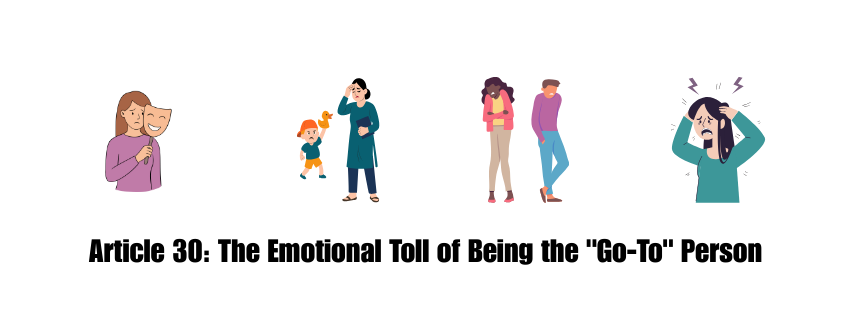
Article 30: The Emotional Toll of Being the "Go-To" Person
Every household has someone who’s the default. The go-to person. The one everyone turns to when something needs doing, when something breaks, when emotions run high, or when someone forgets. For many women, that role becomes more than a responsibility — it becomes an identity. And over time, it takes a toll.
Introduction Every household has someone who’s the default. The go-to person. The one everyone turns to when something needs doing, when something breaks, when emotions run high, or when someone forgets. For many women, that role becomes more than a responsibility — it becomes an identity. And over time, it takes a toll.
What It Means to Be the Go-To Person The go-to person isn’t just organized. She’s dependable. She holds the mental map of everyone’s needs. She knows who’s overwhelmed, what’s due tomorrow, when the car needs an oil change, and who’s feeling off.
She is the:
Scheduler
Counselor
Problem solver
Emotional regulator
Logistics coordinator
She becomes the center of everyone else’s functioning — but may feel like she’s disappearing in the process.
The Weight of Being the Anchor Being the go-to person can feel like:
Constantly monitoring everyone else’s emotional states
Being interrupted even during personal time because "you’ll know what to do"
Having no backup, even when you're exhausted
Feeling like things fall apart if you step away
It’s a role built on reliability — but often, it’s supported by personal depletion.
Real-Life Illustration Julie is the first person her kids come to with questions, complaints, and worries. Greg asks her where things are, what they’re doing this weekend, and who’s picking up the dry cleaning. Her parents call her when they need help with bills or appointments.
She’s proud of being capable — but sometimes she wonders, “Who do I go to?”
The Emotional Toll Being the go-to person can lead to:
Chronic fatigue
Emotional numbing
Heightened irritability
Loss of identity outside of service roles
A deep longing for someone else to notice and act without being asked
It creates a pressure cooker of quiet distress: no one seems to realize the weight — and it keeps piling up.
Why It’s So Hard to Step Back Stepping out of the go-to role is hard, especially when it’s tied to self-worth. Many women have internalized the belief that being needed equals being valuable. Letting go of that can feel like abandonment — not just of others, but of your own identity.
There’s also fear: “If I stop, who will step in?” And the answer isn’t always obvious — especially if others have become used to not needing to.
Changing the Narrative It’s possible to stay reliable without becoming invisible. That starts with:
Naming the role and its impact
Asking for shared responsibility
Teaching others how to step in, then letting them do it their way
Creating boundaries that protect your energy and peace
Partners and family members can support this shift by:
Noticing and acting without prompts
Asking what they can take over long-term, not just temporarily
Validating the go-to person’s fatigue and honoring their need for rest
Reflection Prompt Do you feel like the go-to person in your home or extended family? What would it look like to share that role more equally?
Conclusion Being the go-to person can feel empowering — until it starts to feel like a trap. When everyone leans on one person, that person gets worn down. But it doesn’t have to stay that way. When responsibility is shared and visibility is restored, the go-to person can finally exhale — and reclaim the parts of herself that have been waiting for space.

Article 6: Remembering Tasks as Part of Mental Load
Introduction One of the most overlooked yet mentally taxing components of the mental load is remembering. It’s not just about memorizing dates or items on a to-do list. It’s about holding the cognitive responsibility for an entire household’s needs, timelines, and preferences — and doing it around the clock. Remembering, in this context, is not passive. It’s an active and constant task, quietly demanding energy and attention.
Introduction One of the most overlooked yet mentally taxing components of the mental load is remembering. It’s not just about memorizing dates or items on a to-do list. It’s about holding the cognitive responsibility for an entire household’s needs, timelines, and preferences — and doing it around the clock. Remembering, in this context, is not passive. It’s an active and constant task, quietly demanding energy and attention.
What She’s Remembering The scope of remembering stretches across every aspect of family life. It includes:
Doctor appointments for each family member, along with vaccine schedules and insurance paperwork
School events, permission slips, spirit days, and homework deadlines
Birthdays of extended family, friends, teachers, and the planning that follows
Grocery staples, household items running low, and seasonal needs like sunscreen in summer or coats in winter
Who likes what — favorite snacks, bedtime routines, and emotional triggers to avoid
What needs to be done today, tomorrow, this weekend, and even next month
This kind of remembering isn’t just about recalling information. It’s also about acting on that memory at the right time. It’s remembering to remind others — to make sure the lunchbox is packed, the bill is paid, or the teacher gets the email in time. It’s remembering to send thank-you cards, to RSVP, and to check on a sick friend. And it’s all happening in her head.
Mental Load in the Form of Mental Tabs Many women describe the sensation as having dozens of mental tabs open at all times. These tabs aren’t closed until the task is fully completed — and often, new tabs are constantly opening. The moment a task is done, another is waiting. And remembering is the thread that connects them all.
This is where mental fatigue builds. Unlike physical tasks, which have a start and a stop, remembering doesn’t rest. It’s ongoing, recursive, and layered. Even at night, the brain might be ticking through things to do the next day, worrying about what was forgotten, or mentally rehearsing a conversation to prepare for an upcoming task.
The Emotional Weight of Remembering for Others Part of what makes remembering so heavy is that it’s often done on behalf of everyone else. She doesn’t just remember her own schedule — she remembers everyone’s. She anticipates needs that others don’t even know they have yet. That includes:
Prepping the diaper bag before someone even thinks of leaving the house
Recalling when the last oil change was
Noticing when the cleaning supplies are running low, before anyone else notices the mess
Making sure there are snacks when an activity might run into a time when someone could get cranky from hunger
If she forgets, it impacts the whole family. And if she remembers, no one notices — because everything goes smoothly. This creates a no-win scenario where her success is invisible, and her occasional mistakes are highly visible.
Real-Life Illustration A mom, Julie, doesn’t just remember to bring snacks to the soccer game. She remembers that her spouse, Greg, boss’s birthday is next week. She recalls when the dog needs flea medication. She knows which neighbor is allergic to nuts and which child is terrified of balloons. None of this is written down. It’s stored, cross-referenced, and automatically updated — all in her head.
When Greg forgets something, Julie typically catches it before it becomes a problem. But who catches it for Julie? Often, no one. That’s why she feels so overwhelmed — because remembering is not just a skill. It’s a responsibility that weighs heavier the longer it’s carried alone.
What Happens When the Memory Keeper Burns Out When the person who remembers everything starts to burn out, things fall apart. Appointments get missed, meals are skipped, routines break down, and stress levels rise for everyone. Yet, burnout doesn’t usually come from a single event — it builds slowly, over years of silent remembering with little recognition.
Reflection Prompt Think about the last time you were reminded of something important. Who reminded you? Who’s holding the calendar, the checklist, the birthdays, the grocery staples, and the family stories? Ask yourself: Am I sharing the work of remembering, or relying on someone else to do it all?
Conclusion Remembering is one of the most invisible and underestimated aspects of the mental load. But its impact is profound. By becoming more aware of what your partner is holding in her head — and by actively taking responsibility for remembering alongside her — you lighten the load, strengthen the partnership, and create a more balanced, connected life together.